Cap and Trade – Grandfathering

Cap and trade is a method of regulatory intervention to reduce carbon emissions. Here, the system sets a maximum value for the emissions (cap). It also provides allowances, in emission permits, to firms to cover each unit of CO2 (or any other pollutant) produced. The company can redeem one for every emission unit or trade it to another party, who can then use it.

The regulator can issue permits to the firm in two ways. It can give away permits for free (based on some criteria) or auction them. Allocating permits based on past emissions is called grandfathering.

Mathematically, economists proved that the fee of permits has no impact on the price of the product. If p is the price, q is the output, c(q) is the cost of production, pp is the permit cost, and A is the free permit.

1) For zero free permit
profit = p q – C(q) – ppq
The firm maximises its profit with respect to quantity,
d(profit)/dq = p – C'(q) – pp = 0
price of the product, p = C'(q) + pp

2) For ‘A’ free permits
profit = p q – C(q) – (ppq – A)
The firm maximises its profit with respect to quantity,
d(profit)/dq = p – C'(q) – pp = 0; A is a constant and its derivative is zero.
price of the product, p = C'(q) + pp

So, in both cases, the product’s price is the marginal cost + the price of the permit. The auction, at least, gives the government some money that can be used to support the people who are the worst affected by the price rise.

Cap and Trade – Grandfathering Read More »
Martin and Big Fish

The story of Martin and Big Fish, taken from ‘An Introduction to Probability and Inductive Logic’ by Hacking, is about risk and insurance.

Marting sells clothes on the streets. His sales are typically about $300 and cost $100. Since he is not registered as a vendor at that location, he gets tickets from the authorities for illegal sales. The fine is $100, and he estimates that they happen about two times on his 5-day week.

The daily expected value of his work is:
(2/5) x (300 – 100 -100) + (3/5) x (300 – 100) = $160.

Now, Big Fish finds Martin offers his stall at a daily rent of $50. Martin’s new return can become 300 – 100 – 50 = 150. Should he agree with this?

It is a trade-off for Martin; his profits come down, but he runs no risk now. It is possible that the number of raids increase in future. The same can happen with the fine amount. By paying the additional $10, he replaced the risk with certainty.

Reference

An Introduction to Probability and Interactive Logic by Ian Hacking

Martin and Big Fish Read More »

Risk Aversion and Insurance

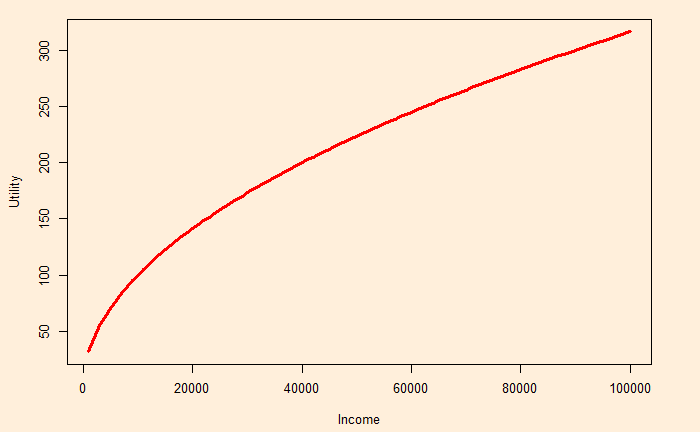
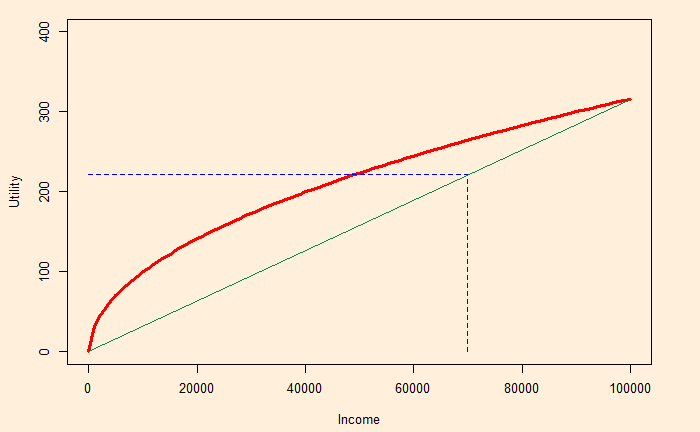
We have seen how risk-averse and risk-taking behave differently given options to take a certain $70,000 or a gamble with a 70% chance of winning $100,000. The former will take $70,000, and the latter will try the luck of winning $100,000. Remember, the expected value of both choices remains the same – $70,000. We have also seen that the utility of that money increases as the square root of the income (decreasing utility rate).

Also, using this example, we will work out the value of guarantees (insurance) for the risk-averse. The utility of the expected value is graphically represented as:

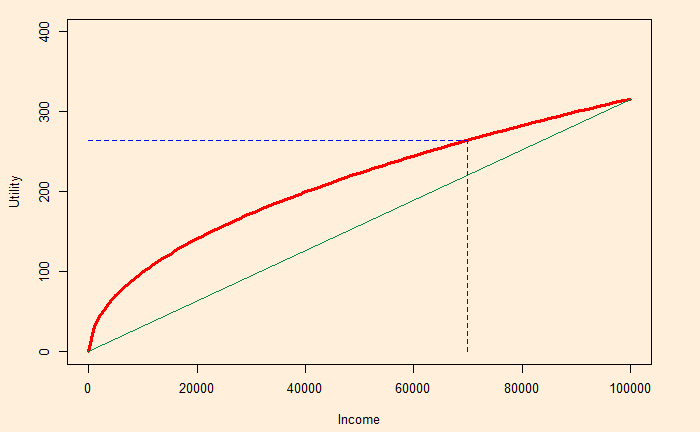
The vertical line touches the X-axis at 0.7 x 100,000 = 70,000, and the expected utility (not the guaranteed) is where the horizontal line touches the Y-axis. We have estimated this value in the previous post as 221.36.

When the income is guaranteed (at 70,000), the corresponding utility becomes:

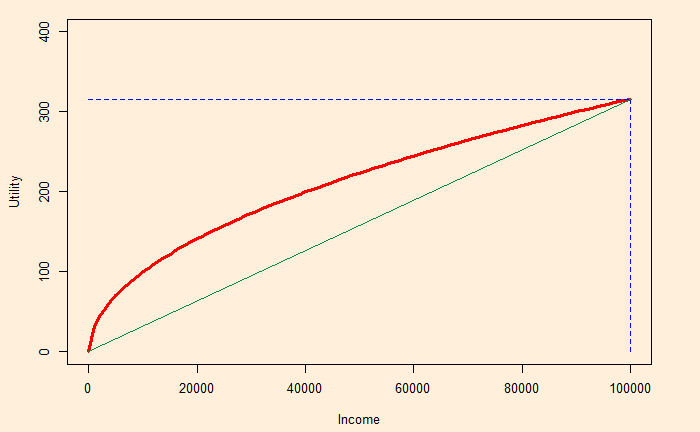
This guaranteed utility is 264.58, which the risk-averse is perfectly happy to accept. Note that the risk-lover is aiming for the full utility. (Although, in the process, she might end up with nothing!)

Insurance

The insurer can guarantee $70,000 at a fee. It is because, whereas it may have to give the individual $70,000, the insurance company knows that if several people gamble, at the end of the day, they will get $70,000. In other words, the expected value exists for the entity that oversees hundreds of gambles and not for the individual who only sees 0 or 100,000. And the fees become the profit for the company.

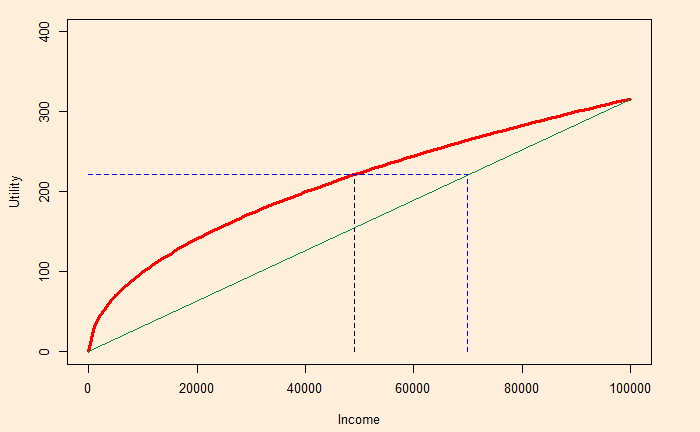
Look at how much income the gamble is worth (with certainty). It is the point at which the black dotted line hits the X-axis in the representation below:

It is about 49,000 in our example. The insurer absorbs it and promises 70,000. The individual and insurer may split the difference (70,000 – 49,000 = 21,000). Say, in one case, the insurer charges 5,000 as the fee, leaving the person with 65,000, equivalent to a utility of $253.

Risk Aversion and Insurance Read More »

Insurance and Risk

Let’s go one step further in the expected utility story. Here, we use the same utility function, I1/2, but a different probability of success. This time, the gamble has a 70% chance to get 100,000 vs. 30% chance to lose everything. The expected value is
0.7 x 100,000 + 0.3 x 0 = 70,000

The expected utility is:
0.7 x(100,000)1/2 + 0.3 x 0 = 221.36

Imagine someone guarantees the expected value (70,000). The utility of this amount is:
70,0001/2 = 264.58

Surely, the second person, who is guaranteed the value, is happier. In other words, the risk is removed, or certainty is added in the second case. So, the question is: what is the price of that ‘insurance’?

Insurance and Risk Read More »

Maximum Willingness to Pay for Insurance

We have seen what expected utility is and how it’s different from the expected value. Suppose Amanda earns 100,000 dollars a year and has a 1% chance of getting sick. The cost of sickness is 50,000 dollars (on medical bills). Amanda’s utility function is:

U = I1/2; where I is the income.

What is her maximum willingness to pay for insurance that covers 50,000 dollars in medical bills?

The maximum willingness to pay is the price, at which she is indifferent between buying the insurance and not. Therefore,

Expected utility with insurance = Expected utility without insurance.
(100,000 – P)1/2 = 0.99 x (100,000)1/2 + 0.01 x (100,000 – 50,000)1/2
P = 100,000 – [(0.99 x (100,000)1/2 + 0.01 x (100,000 – 50,000)1/2)]2
P = $585

Maximum Willingness to Pay for Insurance Read More »

The Principle of Insufficient Reason

Also known as the principle of indifference states, if you have a bunch of theories and don’t have a reason to prefer one of them, then they all get the same prior probability.

1) what is the probability that the trillionth digit of pi is 5? Well, until you do the calculations, the prior probability is 1 in 10.

2) Andy knows his friend Becky will arrive at the City airport between 9:00 and 10:00. Five airlines land between these timings. Airline A and B on terminal 1, C and D on terminal 2 and E on terminal 3. What should Andy do? He can eliminate terminal 3 (the lowest probability of 1/5) and then toss a coin and decide between 1 and 2 (equal prior probabilities of 2/5 each) accordingly.

The Principle of Insufficient Reason Read More »

Electricity Production – Power – Energy Gap

We have seen the carbon intensity of the various national electric grids in the previous post. India is one of the countries with a reasonable growth of renewables – 40% installed power of non-fossil fuel-based electricity – yet with one of the higher carbon intensities in the group with 632 gCO2/kWh. We use that example to explain the difference between power and energy.

Power vs Energy

Power, defined as W, kW, MW etc., is the capacity of the generator to deliver the electric energy. And energy is what is delivered by the machine to do work. For example, if a one MW system runs for one hour, it produces 1 MWh of energy. In other words, a 1 MW system delivers 8.76 GWh of energy a year if it works full-time (1 x 24 x 365). But, if the same generator works only 10% of the time, it produces 876 MWh.

Capacity factor

We have encountered it before. It is the actual amount of energy obtained (in MWh) in an average hour of the year if you install a one MW plant. You can get it by dividing the exact electricity output by the maximum possible.

Let’s look at India’s electricity production (excluding utility and captive Power).

And the installed power,

You can see the issue: the installed power from non-fossil-fuel-based electricity production is in the 40s, whereas the energy contribution is only in the 20s. The capacity factors are estimated by dividing the power with the corresponding energy for a 24-running generator.

Note the low capacity factor for the gas generators. It is not an inherent problem of gas turbines but is likely due to controlled production as a flexible means to manage the peak load requirements.

Reference

CO2 Emissions in 2022: IEA
Electricity production: Enerdata
Carbon Dioxide Emissions From Electricity: world-nuclear.org
Greenhouse gas emissions: Our World in Data
Electricity Mix: Our World in Data
Electricity sector in India: Wiki
Renewable energy in India: Wiki

Electricity Production – Power – Energy Gap Read More »

Electricity Production – Power and Energy

The global emissions of CO2, which is about three-quarters of all greenhouse gases, stood at 36.8 Gt in 2022. A third of the CO2 comes from power production. Reduction of CO2 intensity, therefore, is crucial for a few reasons. First, it reduces the present emissions. More importantly, a cleaner grid catalyses future decarbonisation of other industries via electrification.

The carbon intensity of electric grids, expressed as grams of CO2 per kWh of electricity produced, is presented below.

You can see in the plot that the global average is ca. 436.34 gCO2/kWh. Coupled that with 28,528 Terrawat-hour (TWh) of electricity production in 2022, you get 436.34 (gCO2/kWh)* 28528 (TWh) /1e6 = 12.45 Gt CO2.

There are two commonly used units for the power production of an area – energy produced and the installed power. And they often cause some confusion. That is next.

Reference

CO2 Emissions in 2022: IEA
Electricity production: Enerdata
Carbon Dioxide Emissions From Electricity: world-nuclear.org
Greenhouse gas emissions: Our World in Data
Electricity Mix: Our World in Data
Electricity sector in India: Wiki
Renewable energy in India: Wiki

Electricity Production – Power and Energy Read More »

Complex Coin-Toss

Here is a game. If you win the game, you get a dollar; else, you lose one. What is the probability of winning the game?

The game involves a fair coin and two urns.
Urn 1: 3 red balls; 1 blue ball.
Urn 2: 1 red ball; 3 blue balls.
You toss the coin first. If heads, you draw a ball from urn 1 and if tails, urn 2. Drawing a red ball wins the game.

The marginal probability of getting a head is 1/2, and getting a red ball from Urn 1 = 3/4. Therefore, the joint probability of getting a red ball from Urn 1 is (1/2)x(3/4) = (3/8). Similarly, the joint probability of getting a red ball from Urn 2 is (1/2)x(1/4) = (1/8). The overall probability of drawing a red is

(3/8) + (1/8) = (4/8) = (1/2), same as flipping a coin.

Complex Coin-Toss Read More »

Affirming the Consequent

You must have heard similar arguments.

  1. If the lamp is broken, then the room will be dark.
  2. The House is dark.
    So:
  3. The lamp must be broken.

Or another:

  1. Binge drinking leads to liver cirrhosis.
  2. He has liver cirrhosis.
    So:
  3. He must be a binge drinker.

Affirming the consequent is a logical fallacy that starts from a true statement and jumps to the conclusion that the converse form would be true by ignoring alternative explanations. In other words, the truth of the premises can not guarantee the truth of the conclusion. Take the first example: there may be other reasons why the room is dark. It can be a power failure or someone just switched off the light.

‘the lamp is broken’ and ‘binge drinking’ are the antecedents of the arguments. The consequent in the first example is ‘the room will be dark’, and for the second example, it is ‘ liver cirrhosis.’

Smoke without fire

Then there is this proverb, “There’s no smoke without fire”. Like so many other proverbs, this one is also a fallacy.

If fire, then smoke
smoke
So:
fire

Well, there could be a smoke machine, or someone mistook fog as smoke!

Reference

Affirming the consequent: Wiki

Affirming the Consequent Read More »