Life

Jevons Paradox

Jevons paradox is a term associated with behavioural economics in which one, often a policymaker, expects a substantial decrease in energy consumption by replacing a lower efficiency unit with a higher one, instead finding only a marginal drop, or worse, an increase. It is also sometimes called the rebound effect.

Mexico’s C4C program

An example is a study by Davis et al. on the Cash for Coolers (C4C) program that ran in Mexico. C4C was a large-scale replacement program started in 2009 that helped ca. 1.5 million households to replace old refrigerators and air coolers with new energy-efficient (> 5% from the 2002 standard) ones. In return, the household can get up to $185 in subsidies.

A World Bank study, for example, estimated a savings of 481 kWh/y from the change out of refrigerators. In reality, Davis’ study found that the real benefit was about 11 kWh per month which translated to 11 x 12 = 132 kW/y, just over a quarter of what was originally envisaged.

Increased consumption from coolers

The air conditioner story was even more dramatic. After the substitution with the more energy-efficient ones, the overall energy consumption increased!

There can be different explanations for what happened. But one thing is clear – the implementor had made inaccurate assumptions about consumer behaviour. It is possible that in the process, the household got a chance to turn in some of the old, unused appliances in return for a subsidised new one.

Jevons Paradox Read More »

Population but No Explosion

We have covered the topic of the population a few times already. Parameters such as fertility per woman and population growth rates started their downward journey for most countries some time ago. Take the top four populous countries in the world, China, India, the US and Indonesia.

ChinaIndiaUSIndonesia
Population
growth rate (%)
(1963)
2.462.061.442.66
Population
growth rate (%)
(2019)
0.3551.010.4551.1
Child per woman
(1963)
~65.883.355.63
Child per woman
(2021)
1.662.221.892.24

8 Billionth Child

But today is a special day. The United Nations considers 15th November 2022 as the official day of the birth of the 8th billionth child. It took 11 years for the number to go from seventh billion to eighth. And it will take another 15 years to reach ninth. Based on the UN estimates, the global population will peak somewhere between 10 and 11 billion.

The question is: how reliable is this UN estimate? The answer comes from a study published in 2001 by Nico Keilman. The publication explored 16 sets of population projections by the UN between 1951 and 1998 and concluded that they did a decent job of predicting population. Following are the Mean absolute percentage error (MAPE) of those studies.

Base YearMAPE
1950I12.6
1950II11.2
1950III3.5
19601.8
19652.2
19701.5
1975I0.6
1975II0.2
1980I0.2
1980II0.2
1985I0.9
1985II0.9
1990I1.1
1990II0.6
1995I0.4
Mean absolute percentage error (MAPE) in projected total population size

References

Population forecast: Gapminder
8 billionth child: BBC
The world’s population has reached 8 B. Don’t panic: The Economist
Keilman, N., Population Studies, 2001, 55, 149

Population but No Explosion Read More »

The Happiness Formula – Experience vs Memory

We started this blog stating that the “Thoughtful Examinations” was about life, knowledge, and happiness, yet we have spent the least amount of time, so far, on the topic of happiness, but not today. Let us start with a question: what causes happiness?

Before answering the question, we will briefly consider the two kinds of experiences of happiness. As per Nobel laureate Daniel Kahneman, they are the experiencing self and remembering self. The former is about joy, or the pain someone undergoes at a given moment, and the latter is about how she remembers it later.

Kahneman’s team conducted an experiment in which he collected data from 682 patients undergoing the colonoscopy process. As you may know, a colonoscopy is not a pleasant experience. It was a randomised control test (RCT) in which the group was divided into two – the first group was called the normal, and the second was the modified.

Adding a minute of happiness

For the normal group, it was the standard colonoscopic procedure, whereas, for the modified group, the researchers added a few minutes of a non-pharmacologic intervention by extending the duration with lessened pain to the patient. The tip of the colonoscope was allowed to rest in the rectum for about 3 minutes without any suction or inflation.

The assessment used the so-called Gottman–Levenson approach: the participants (patients who authorised the researchers to collect data) got a handheld device through which one can mark the extent of pain at regular intervals, from no pain (score = 0) to extreme pain (score = 10).

The end makes a difference

The study results were evaluated on two parameters – the patient’s feedback to a questionnaire and the rate of return for a follow-up colonoscopy. The questionnaire was a retrospective evaluation of how a participant felt about the procedure. The results were significantly different from each other. The patients who received the modified treatment remembered the whole event as less painful, although the beginning, the middle part and the peak pains were comparable to both groups.

The Happiness Formula – Experience vs Memory Read More »

The Myside Bias

The last few posts covered one important aspect of our irrationality. That it is beyond the education level or other types of cognitive deficiencies, but purely ideological. The author Steven Pinker calls it the myside bias.

The Myside Bias Read More »

Motivated Reasoning – Climate Change

The irrationality of the public on subjects of global impacts, such as climate change, has been explained using three dominant theories. They are 1) the scientific illiteracy theory, 2) the bounded rationality theory, and 3) the cultural cognition theory. The first assumes that most people lack the science education to understand the complex nature of global warming. The second one goes hand in hand with Kahneman’s definition of system 1 (fast) and system 2 (slow) thinking. The third one concerns the perception of risks and how they fit with an individual’s value systems.

To apply this to climate change: a familiar narrative is that the average public lacks the capacity to comprehend the science behind it and therefore resorts to some form of heuristics to understand, which is often governed by her beliefs. The name associated with this portrayal is the public irrationality thesis (PIT).

Application to climate change

Kahan et al. have applied the theory to testing. Contrary to the expectation, in his first test (N = 1540), he found that increased science literacy and numeracy did not increase the risk perception of climate change; in fact, it slightly decreased!

On the other hand, the study found that an egalitarian individual (communitarian) is more likely to have a higher risk perception of climate than a hierarchical person (individualist). It remained the same or slightly increased with her numeracy. It was striking that the hierarchical individualist did not progress her risk perception as a function of numeracy; instead, it slightly reduced!

Nuclear risk

On the other hand, to answer the question about the impact of nuclear power on human health and safety, both types of individuals showed reduced perceived risks as a function of their literacy.

Beliefs over rationality

Both these data suggest that increasing science education and numeracy is not necessarily to help detach oneself from her beliefs.

Motivated Reasoning – Climate Change Read More »

Red Herring Fallacy

It is a logical fallacy used in debates to distract the argument by introducing an irrelevant topic, usually loaded with emotions, into the discussion to divert the opponent.

The name comes from an old method of training dogs in fox hunting. In this process, before the dog (to be trained) leaves in search of the fox that just left by following the scent, the trainer drags a bag of smelly red herrings on the trail. Some dogs will get distracted by the strong smell of the fish and stop following the fox. The trainer then tries and keep the dogs to stay on course.

How is the red herring different from the straw figure fallacy? In some aspects, they seem similar. In the latter case, the original argument is distorted or misrepresented, and the new subject becomes the target. But in the former case, the initial point is completely ignored and is substituted with a new one, which gets attacked.

Red Herring Fallacy Read More »

Time Travel Paradoxes

Let’s see two paradoxes that can exist if you can time travel.

The first one is the grandfather paradox. Imagine you can time travel, go back to the past, and kill your grandfather before he met your grandmother. That means he did not have children, and you could not be born in the first place (to time travel)!

The second one is the bootstrap paradox. You buy a copy of Hamlet from a bookshop and go back to the time before William Shakespeare has written Hamlet. You give the book to William. He then copies it and claims his own. Years passed, and the book made several copies. One of them enters the same bookshop you originally visited. The question is: who wrote Hamlet?

A direct consequence of these paradoxes could be that there is no time travel possible. Another possibility is that a parallel universe is created as a result, and your existence (and Hamlet’s) is real in one of them.

Time Travel Paradoxes Read More »

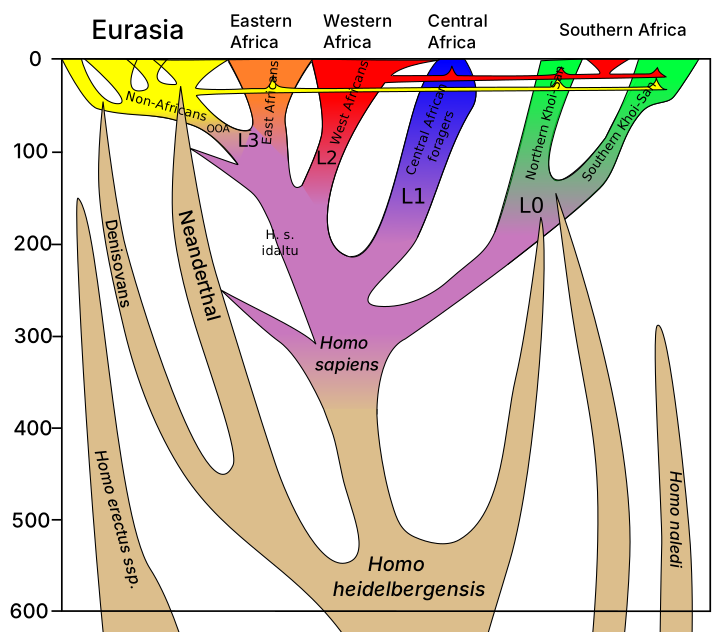
Neanderthal mother and a Denisovan father

We have seen that the Neanderthals lived in Western Eurasia and Denisovans in Eastern Eurasia (basically, Denisova cave). The 2018 report by Slon et al. provides the DNA analysis of a bone, Denisova 11, that comes from an individual who had a Neanderthal mother and a Denisovan father!

The previous sequencing had established that the Neanderthals and Denosovals diverged from each other by about 390 kya. It is, therefore, fascinating to note what was found in the Denisova 11 sample. The mitochondrial (mt)DNA showed it was a Neanderthal type, and carbon dating said it was more than 50,000 years old. And what is more: 38.6% of its DNA fragments possessed alleles matching the Neanderthal genome, and 42.3% carried alleles matching the Denisovan genome!

Reference

The genome of the offspring of a Neanderthal mother and a Denisovan father, 2018, Nature, 113

Neanderthal mother and a Denisovan father Read More »

Post # 365: What Have We Learned in One Year?

We started with the equation of life, Bayes’ theorem, how it mimics the natural learning process, and how even experts can not escape the curse of the base rate fallacy.

We understood the law of large numbers but failed to notice that there was no law of small numbers and continued gambling, hoping to even out, leading to complete ruin.

We have learned mathematically that at the Roulette table, the house always wins, yet we spent countless minutes watching YouTube videos learning strategies to beat the wheel. We also watched financial analysts all day on TV, reasoning on hindsight and glorifying market-beating fund managers, forgetting they were just the survivors of Russian roulette. The same people continue to make us believe in momentum and hot hands.

People gamble and play the lottery, where they are guaranteed to lose, and fail to invest for their retirement, where they are guaranteed to win. Three-quarters of Americans believe in at least one phenomenon that defines the law of physics, including psychic healing (55 per cent), extrasensory perception (41 per cent), haunted houses (37 per cent), and ghosts (32 per cent).

Rationality, by Steven Pinker

We have seen how journalism can mesmerise readers by reporting an 86% increase in myocarditis for the vaccinated, a 300% increase in thrombosis over oral contraceptives, or an 18% risk of colorectal cancer by eating processed meat. We just became easy prey for our inability to make decisions based on risk-benefit trade-offs and the eternal confusion between absolute and relative risks.

We found how the world can make us believe in diseases with causes and designs with a purpose when events were nothing but random processes. We see how careless choice of words and phrases and incorrect teaching lead to myths about evolution.

Even in an era of open data, data science and data journalism, we still need basic statistical principles in order not to be misled by apparent patterns in the numbers.

The Art of Statistics: How to Learn from Data, by David Spiegelhalter

The author was referring to variabilities in the observed rates of events when the population is small, which is the concept behind funnel plots.

We understand that international trade is a win-win for both parties, yet we let free rein to populism and Brexit. We know that the Muslim community in India is on the fastest downhill in the fertility curve, yet we want to believe that the opposite is true and continue believing in one-child policies.

We also know that life is not a zero-sum game and that probability theory is not another useless thing you study in schools and forget later, but it is about how we make decisions and appreciate life. The understanding, or the lack of it, can be a choice between life and death, as we have just witnessed in the global pandemic.

Could everyone have a fact-based worldview one day? Big change is always difficult to imagine. But it is definitely possible, and I think it will happen, for two simple reasons. First: a fact-based worldview is more useful for navigating life, just like an accurate GPS is more useful for finding your way in the city. Second, and probably more important: a fact-based worldview is more comfortable.

Factfulness, by Hans Rosling with Anna Rosling Rönnlund and Ola Rosling
Post # 365: What Have We Learned in One Year? Read More »

The Denisovan Story

Another spectacle that emerged from Pääbo’s group was the discovery of Homo Denisovans from a bone sample excavated in Denisova Cave in southern Siberia. They possess the type of hominin mtDNA that shares a common ancestor with modern human and Neanderthal mtDNAs. And the stratigraphy of the location suggested the new samples lived at similar times to Neanderthals.

Where do they stand?

If we define the timelines as a function of pair-wise nucleotide differences of the complete mitochondrial DNA (mtDNA) from modern humans, Denisovans existed about 385 units away from humans. To put it in perspective: the modern humans are between 0 – 100, the Neanderthals at around 202 and the Chimpanzees at 1462.

Interbreeding

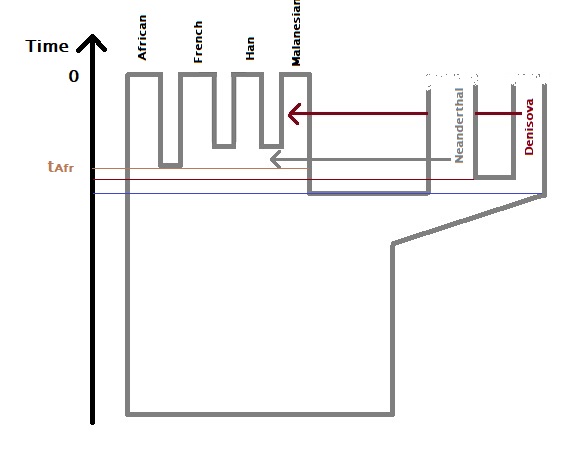
The researchers then searched for gene flow (interbreeding) similar to what was found with the Neanderthals using the five samples (San, Yoruba, Papua New Guinean, Han Chinese, and French) from modern humans. This time, there was no overlap between the French and the Han but found ca. 4% match with the Melanesian.

The new representation, combining the findings of the two studies (genome sequencing of Neanderthal and that of Denisovan), is presented below.

Reference: https://commons.wikimedia.org/w/index.php?curid=65505773

References

Krause et al., The complete mitochondrial DNA genome of an unknown hominin from southern Siberia, NATURE, 2010, 464, 894

Reich et al., Genetic history of an archaic hominin group from Denisova Cave in Siberia, NATURE, 2010, 468, 1053

The Denisovan Story Read More »