Life

Republican Bayes

Let’s answer this question. In the Pew Research Center poll results published in 2010, 53% of Republicans, 14% of Democrats and 31% of Independents answered NO to the question, is there solid evidence that the earth is warming?
If a respondent answered no, what is the probability that she is a Republican? Note that on this survey on Oct 13-18, 2010, 25% of the participants were Republicans, 31% were Democrats, and 40% were Independent.

Let’s use the general formula of Bayes’ theorem here:
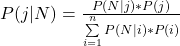
\\ P(j|N) = \frac{P(N|j)*P(j)}{\sum\limits_{i = 1}^{n} P(N|i)*P(i)}

Here, j represents Republican, and ‘i‘ represents a Republican, Democrat or Independent. So the required probability that a person is a Republican, given that she answered NO, is:

P(R|N) =  \frac{P(N|R)*P(R)}{P(N|R)*P(R) + P(N|D)*P(D) + P(N|I)*P(I)} \\\\ \frac{0.53*0.25}{0.53*0.25 + 0.14*0.31 + 0.31*0.4} = 0.44

So, there is a 44% chance that the random person is a Republican: no better than flipping a coin!

Increasing Partisan Divide on Energy Policies: Pew Research
Republican Bayes Read More »

Three-parent baby

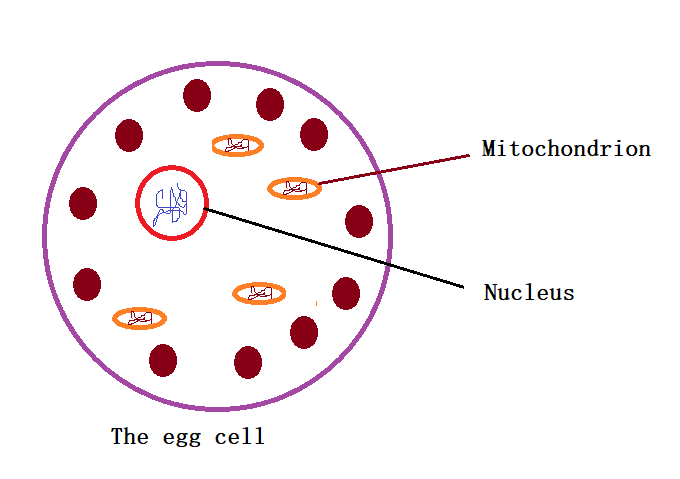
We have seen Mitochondrial DNA (mtDNA) as a valuable tracer to follow maternal ancestry. To take a step back: the majority of human DNAs reside inside the cell nucleus, and a few are inside another structure inside the cell, the mitochondrion. During reproduction (fusion of egg and sperm), nuclear DNA undergoes recombination with material from both parents participating, whereas mtDNA we possess entirely comes from the mother’s ovum. It happens due to the faster degradation of mitochondria from the sperm during fertilisation.

Leigh syndrome

Leigh syndrome is a fatal disorder, and its genes reside in the DNA of the mitochondria. If the mother has the disease, it’s sure to reach the offspring, jeopardising its health. In 2016 John Zhang’s team at the New Hope Fertility Center in New York City found a solution. They ‘swapped’ the mitochondria of the mother with a healthy donor.

The technique was to take a healthy donor egg, remove the (cell) nucleus and replace it with that from the mother. Scientists then fertilised the egg with the father’s sperm and implanted it into the mother’s womb. While the majority of the genetic material is from the mother and father, those from the mitochondria are from the donor, thus making her the ‘third parent’.

World’s first baby born with New “3-parent” Technique: New Scientist
The three-parent baby technique could create babies at risk of severe disease: MIT Technology Review

Three-parent baby Read More »

Free and Unlimited

The concept of FREE! is one of the most compelling forces on human irrationality. Based on many examples, it has been proven that the market power of FREE! is not an extrapolation of discount.

In a famous experiment by Shampanier et al., the researchers offered to the participants a choice between Hershey’s (low-value chocolate) and Lindt truffle (high-value) for three different price offers – (0&14), (1&15) and (0&10). The first number inside the bracket refers to the price of Hershey’s in cents, and the second is that of Lindt. And the results showed the demand for Lindt dropped from 36% to below 20% in both the FREE! options and that of Hershey’s went up from 14% to 40%. Note that 40-50% of the participants opted for nothing.

In the real world, the appeal to free and unlimited has been hailed as a blockbuster success story behind India’s Jio telecom company. When it was launched for the public in September 2016, Jio SIM cards were available for free, along with 4GB of data a day, for three months. And the results? The Indian telecom industry, which had six players at that time, was reduced to four, and Jio captured about 350 million subscribers today.

Dan Ariely, Predictably Irrational

Shampanier et al., Zero as a Special Price: The True Value of Free Products, Marketing Science, 26 (6), 2007, 742

Free and Unlimited Read More »

News From Huanan Market

After a brief interval, here is some Covid news. A new peer-reviewed article is now available in Nature for preview. The study summarises the RNA sequence results from several samples from Huanan Seafood Market in Wuhan. The market was linked to several of the early cases of the illness. Since the market’s closure (1st of January 2020), 923 environmental and 457 animal samples were collected from 1-Jan to 2-Mar 2020. Here is the high-level summary:

# Samples# +ve by
RT-PCR
Huanan Seafood Market71840
Warehouses145
Other markets301
Drainage11024
Sewerage wells513
Total92373
Summary of environmental sample results

Notably, 35 samples from February showed positive, suggesting a pretty long persistence of the viral material in the environment.

Of the 457 samples collected from animals belonging to 18 species, none of them tested positive for the virus.

While several samples had genetic material belonging to mammals of genera such as homo (e.g. human), ovis (e.g. sheep), bos (e.g. cow), canis (e.g. dog) etc., it is not, however, proof that these animals were infected but may only mean that there was an increased focus (for sample collection) on those shops and locations, where animals were sold. The same goes with the case of racoon dogs as carriers: the study found genetic material from those; it could only mean that two things (virus-carrying entity and racoon dogs) co-existed, and nothing further.

Reference

Surveillance of SARS-CoV-2 at the Huanan Seafood Market: Nature

News From Huanan Market Read More »

IESDS – Infering Each Other

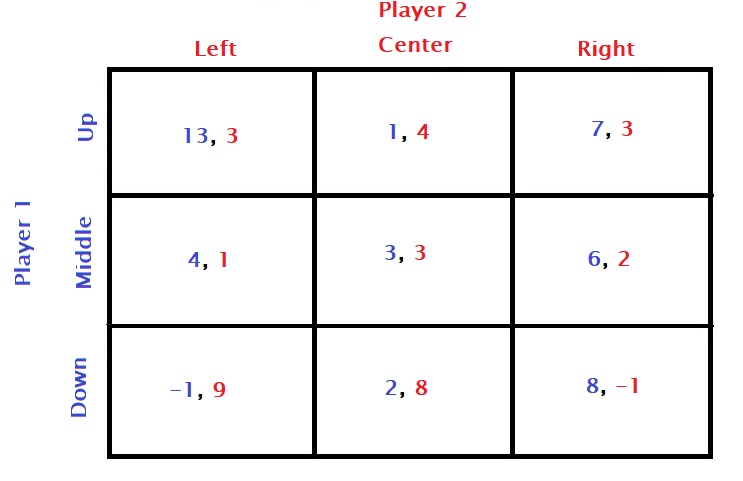
See a game played between two rational players with the following payoff matrix.

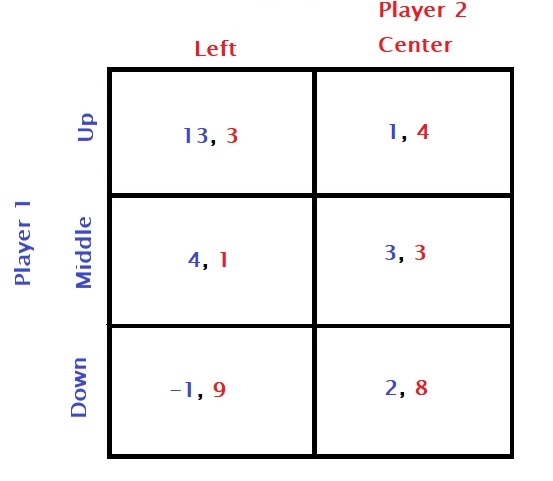
Looking at the matrix, one can see that player 2 is unlikely to choose the right strategy as her payoffs, 3, 2 and -1, are worse off against left and centre. So for player 2, the matrix is the following.

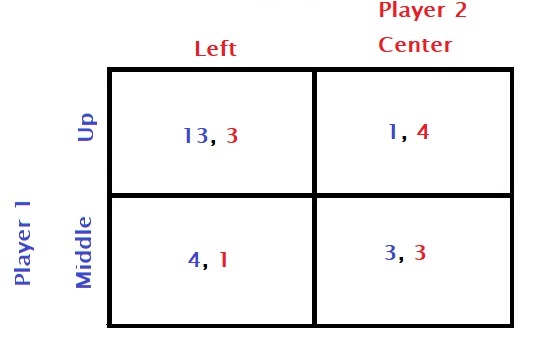
Player 1 knows what Player 2 is thinking because she is also rational. She looks at her options and concludes that down is no longer an option for her (- 1 < 4 and 2 < 3). So he eliminates the row corresponding to down.

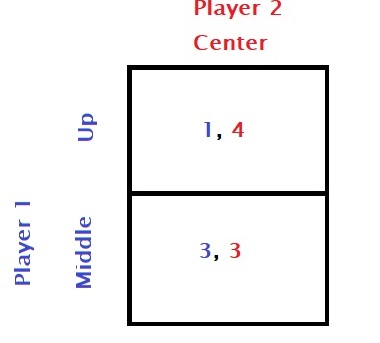
Player 2 knows that the option down is the least favourite to Player 1, so she compares options left and centre. Centre dominates (4 > 3 and 3 > 1).

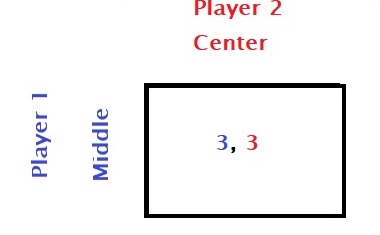
If that is the case, Player 1 will choose the middle, which gives her a better incentive.

The whole game structure is common knowledge between the two players. Such games are known as iterated elimination of strictly dominated strategies or IESDS.

IESDS – Infering Each Other Read More »

Strategies of a Game

Based on what we have seen so far, let’s put together three strategies for games we have encountered in the past. But before delving into those, look at Nash’s theorem, which suggests that there must be at least one Nash equilibrium in all finite games. Watch out for those two words: Nash equilibrium and finite games!

A finite game has a fixed number of players, a defined set of rules, and a known end.
Nash equilibrium is the state of a game where the player has made her best decision or has no incentive to change the decision, assuming all other players maintain their current strategy.

The dominant strategy

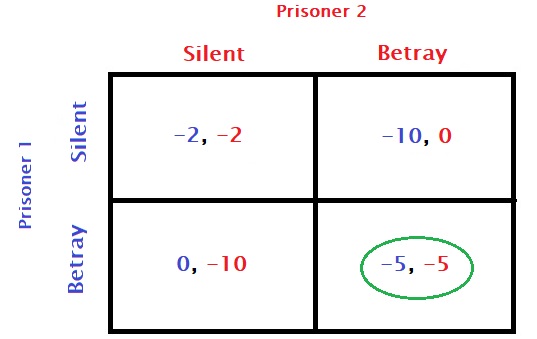
Remember the prisoner’s dilemma? The prisoner has a clear move irrespective of what the others will do. To put it in the language of the payoff matrix,

The pure strategy

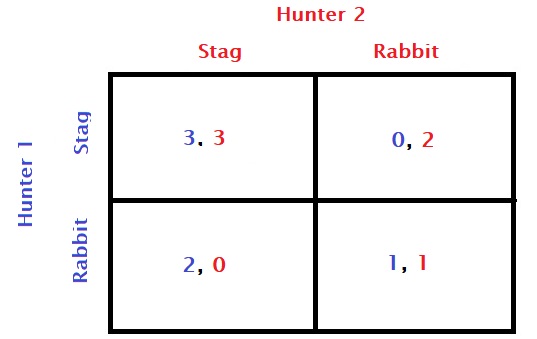
The stag hunt game;

Compare dominant and pure

In the first instance, they may appear the same: one best outcome, one sub-optimal and two places with mixed incentives. But look carefully: in the first game, imagine you are prisoner 1, and think about your reward (the blue number) based on the two possibilities of the other player. If prisoner 2 is silent (first column), then your choice is to betray as 0 > -2 (compare the two blue numbers of the first column). If prisoner 2 chooses to betray (second column), your choice is still to betray as -5 > -10 (compare the two blue numbers of the second column). 100% clarity!

In the second case, repeat the above process. If hunter 2 brings the tool for the stag, the stag becomes your choice (blue 3 > blue 2). If hunter 1 gets the rabbit device, the rabbit is your choice (blue 1 > blue 0).

The mixed strategy

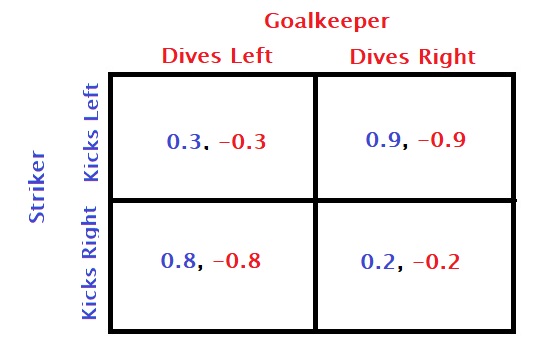
The penalty kick game is an example of a zero-sum game—one person’s win is the other’s loss. There is no pure strategy here; one needs to mix up (randomise) the plan to succeed. In other words, the strategy needs probabilistic estimation.

Strategies of a Game Read More »

Stag Hunt Game

Two hunters want to go to a range which contains one stag and two rabbits. Each hunter will decide on the equipment to bring but won’t know what the other is carrying. Two people are necessary to hunt a stag, but one is sufficient to catch rabbits. And a stag catch is always a better deal as it has more meat.
The payoff matrix is:

Hunter 2
StagRabbit
Hunter 1Stag3,30,2
Rabbit2,01,1

So, if both hunters bring devices for catching stag, they get the maximum benefit (3 each). If only one brings tools for rabbits, that person will get both rabbits. If both get tools for the rabbit, they split one each.

The game has two pure-strategy Nash equilibria – rabbit-rabbit and stag-stag. And the best situation is the latter. On the one hand, this differs from the prisoner’s dilemma because it has a dominant strategy (to betray), and the stag hunt has none. What is similar in both cases is the role of cooperation among players.

In a fully cooperating regime, both players expect the other to bring in tools for stang, and both reap maximum benefit. But if one player has even a slight doubt about the other (that the other will bring an instrument for the rabbit), she has no choice but to get the same tool or end up with nothing.

Stag Hunt Game Read More »

It’s Not Fair!

Inequality aversion is a concept in behavioural economics. It means humans have a notion of fairness and will reject what they consider as inequalities. This psychology is responsible for individuals refraining from targeting higher rewards if they perceive another party getting better incentives. We have seen this in the centipede game.

Kahneman et al. report results from their study in which they carried out telephonic surveys on the residents of Toronto and Vancouver. Each participant got a maximum of five questions regarding fairness in a telephonic interview.

Question 1

A hardware store has been selling snow shovels for $15. The morning after a large snowstorm, the store raises the price to $20. Please rate this action.” 80% of the respondents thought it was unfair.

Question 2

Question 2 has two parts. 2A: An employee is working in a photocopying shop at a wage of $9/hour. Upon seeing unemployment rising in that area and noticing other smaller shops paying $7/hour for their employees, the owner reduces the employee’s wages to $7/hour.
2B: An employee is working as in question 2A. After she leaves, the employer recruits a new person at a wage of $7/hour.

To question 2A, 83% of the respondents replied as unfair, and to 2B, only 27%.

House on rent

Similar ideas of fairness exist in residential tenancy. Different rules of rent-hikes are accepted for a new tenant (higher tolerated) vs a tenant renewing the lease (lower). At the same time, people thought it was ok if the landlord sold the house and the new owner charged higher rent from the existing tenant!

Reference

Daniel Kahneman, Jack L. Knetsch and Richard Thaler: Fairness as a Constraint on Profit Seeking: Entitlements in the Market, The American Economic Review, 1986, 76(4), 728

It’s Not Fair! Read More »

What is in the Envelope

Here is a puzzle. There is a 200 EURO currency in one of the two envelopes, A and B. If you guess the right one, you can get the cash. Additionally, you can avail of a clue, which works as follows: There is a jar with five balls in it – three of them having the alphabet (A or B) of the envelope that carries the currency and two with the other alphabet. You can pick on the ball at random if you like. The price to pay for the clue is 25 EURO. The questions are:

1) Is the clue worth 25 EURO?
2) If not, what is the maximum amount you would like to pay?
3) Would you be willing to pay for a second clue and pick up another ball?

Let’s answer the first question. The expected value from the guess without taking any clues is 0.5 x 200 + 0.5 x 0 = 100 EURO. It is because there is a 50-50 chance that your guess turns right. What is the expected value of the guess with the first clue? It is 0.6 x 200 + 0.4 x 0 = 120 EURO. When you pick one ball, there is a 60% (0.6) chance that it is the right one (3 out of 5) and a 40% chance it is the wrong one.

Therefore, the maximum added value of going for the clue is 120 – 100 = 20 EURO. So, the answer to the first question is NO, and the second is 20 EURO.

What about a second pick? To answer this, we will need to perform several conditional probabilities using our favourite Bayes’ rule, which we’ll do next.

Is Extra Information Helpful? A Probability Puzzle: William Spaniel

What is in the Envelope Read More »

What Asteroid Ryugu Tells Us

I’m sure you remember Miller–Urey experiments that, in the 1950s, generated molecules of life by passing electric discharge over a mixture of methane (CH3), ammonia (NH3), water (H2O) and hydrogen (H2). The molecules reported were amino acids such as aspartic acid, glycine, alanine and alpha-amino butyric acid.

Ferus et al. in 2017 went even further. They shone electric discharge (simulating lightning) and laser (simulating asteroid plasma) on a mixture of NH3, CO and H2O, producing RNA nucleobases – uracil, cytosine, adenine, and guanine.

Straight from space

While laboratory experiments such as these demonstrated the origin of fundamental molecules from simple gaseous species present in the universe, it can never replace evidence from space, the true cradle of these building blocks of life. And that’s what happened when scientists analysed samples from an asteroid.

The team led by Yasuhiro Oba analysed samples collected in 2018 from asteroid Ryugu and found uracil, one of the four bases of RNA.

Pristine sample

The beauty of this sample is that it was uncontaminated by anything from the earth as it was collected and sealed at the asteroid surface by the Hayabusa2 mission.

Studies like these suggest that foundations of life, such as the molecules of interest, might have been formed in carbonaceous asteroids and delivered to the early earth.

Reference

Yasuhiro Oba et al.; Nature Communications, 2023, 14:1292

Asteroid sample study: The conversation

Stanley L Miller, A production of Amino Acids Under Possible Primitive Earth Conditions, Science, 1953

Formation of nucleobases in a Miller–Urey reducing atmosphere, PNAS, 2017

What Asteroid Ryugu Tells Us Read More »