Life

Fourfold Pattern of Decision Making

In prospect theory, we have seen how human psychology slips into irrationality while understanding risks. The fourfold pattern is one such representation; of behaviours that deal with extreme probability events.

Imagine the following four cases of improving the chances of making one mln dollars.
A. 0% to 5%
B. 5% to 10%
C. 50 to 55%
D. 95 to 100%

A robot will perform the following calculations and conclude

A. (0.05 x 1,000,000 + 0.95 x 0) – 0 = $50,000
B. (0.1 x 1,000,000 + 0.90 x 0) – (0.05 x 1,000,000 + 0.95 x 0) = $50,000
C. (0.55 x 1,000,000 + 0.45 x 0) – (0.5 x 1,000,000 + 0.5 x 0) = $50,000
D. (1.0 x 1,000,000 + 0.0 x 0) – (0.95 x 1,000,000 + 0.05 x 0) = $50,000

that, all those situations lead to the same outcome – the robot has just performed an expected value calculation! But humans are not robots, and not all increment (wins or losses) has the same value.

A change from 0% to 5% is a movement from impossibility to a ray of hope. And that triggers the brain disproportionally. In other words, we overestimate that 5%. A classic example is a lottery ticket. How many of us would buy a ticket that expired a month ago? In reality, the chance of winning a lottery is almost the same as that of an expired one! This behaviour is called ‘risk-seeking‘.

On the other hand, progress from 95% to 100% is a change from possibility to certainty. An example is an out-of-court settlement. Assume you have a 95% chance of winning a lawsuit at $1 mln. Your lawyer indicated a 5% chance of losing the case and conveyed the other party’s willingness for a settlement of %750,000. Will you take it? This is ‘risk aversion‘ or underestimation of probability.

Fourfold Pattern of Decision Making Read More »


Game Theory of Marks

This one is picked from the Internet and attributed to a University of Maryland professor. The students have the opportunity to get extra marks. They can select 6 or 2 points, but with conditions: if more than 10% of the students choose 6, no one gets anything. What will be your choice?

Others pick
6 points
Your
Pick
> 10%< 10%
2 Points02
6 points06

So, in either case, you are better off or at least as good off by picking 6.

Game Theory of Marks Read More »

Probability of New Boy

Let’s visit our favourite subject, but after a long gap – the probability and Bayes’ theorem. Here is the question:

A new child arrives in a child-care facility that has three boys and the remaining girls. A statistician visits the centre and randomly picks up a boy child. What is the chance that the newly admitted child is a boy?

Before solving the puzzle, let the number of girls already in the centre be g. Therefore, the total number of children available for the statistician to count is 3 + 1 + g = 4 + g.

The Bayes’ equation is

P(B_n | B_r) = \frac{P(B_r | B_n) * P(B_n)}{P(B_r | B_n) * P(B_n) + P(B_r | G_n) * P(G_n)}

The terms are
P(B_n | B_r) = probability of the new child being a boy given the randomly picked is a boy
P(B_r | B_n) = probability of picking a random boy given the new child is a boy = 4 /(4+g)
P(B_r | G_n) = probability of picking a random boy given the new child is a girl = 3/ (4+g)
P(B_n) = prior probability for the new child to be a boy = 0.5
P(G_n) = prior probability for the new child to be a girl = 0.5

Substituting the terms,

P(B_n | B_r) = \frac{\frac{4}{4+g}*0.5}{\frac{4}{4+g}*0.5 + \frac{3}{4+g}*0.5} = \frac{4}{7} = 57.14\%

Probability of New Boy Read More »

Prospect Theory – Better safe than sorry

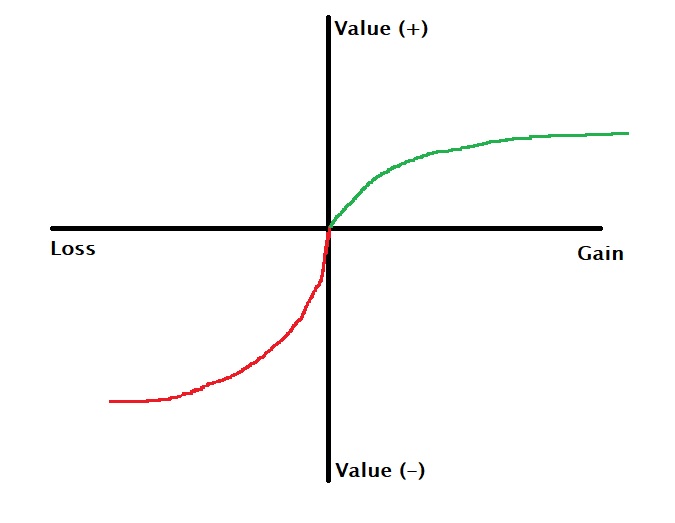
Prospect theory is a behavioural model which explains how people make decisions that involve risk. It has been observed that people take gains and losses differently. In short, to the decision maker, the pain of losing something scores higher over the pleasure of gaining – the risk aversion.

The plot below illustrates the prospect theory. While both the positive side (green part) and the negative side (red part) reflect diminishing marginal utility (flattening towards the higher x values), the initial few gains and losses have distinct shapes. Imagine the feeling you have when you get 100 dollars; compare that with gaining an additional hundred dollars, say from 2000 to 2100.

The fundamental question here is: what defines the origin of the plot? One possibility is that it represents the present state. I can also argue it marks the expectations. An example of the latter is the famous case of silver medal winners. Studies seem to indicate that the second-place winners of sports events were unhappier than the third-place holders, especially when it is contrary to prior expectations.

Daniel Kahneman and Amos Tversky; Econometrica, 47(2), 1979, 263-291
McGraw et al.; Journal of Experimental Social Psychology 41, 2005, 438–446

Prospect Theory – Better safe than sorry Read More »

Peto’s Paradox

We saw possibilities of random errors during cell divisions leading to mutations. Despite all the corrective mechanisms that the body has, some of those can lead to genetic diseases such as cancer. Naturally, one would expect the probability of cancer to be proportional to the number of cell divisions. If you extrapolate the logic further, it is logical to conclude that the number of cells, the larger the animal, will lead to more occurrences of cancer.

In other words, an elephant has more probability than humans, which, in turn, has a lower chance than a blue whale. But that is never seen in real life. This lack of correlation between animal size with the propensity to get cancer is known as Peto’s Paradox.

Peto’s paradox: Wiki
What is Cancer: NIH

Peto’s Paradox Read More »

Long-Term Evolution Experiments

The Long-term Experimental Evolution Project of Prof. Richard Lenski’s team at Michigan state university is a significant movement in our understanding of evolution. The team so far has achieved three decades of evolution of E.Coli bacteria in their laboratory. That corresponds to more than 76,000 generations of the organism starting from the common ancestor, noting that it goes through six or seven generations per day!

The experiments started with growing bacteria colonies in a petri dish and taking small sub-samples to 12 flasks containing a solution of glucose, potassium phosphate, and citrate at 37 oC. On the next day, 1% of the sample from the flask is transferred to a fresh sterile flask. And the process has been repeated every day for the last 34 years.

For humans, 76,000 generations could mean more than 1.5 million years. But does it mean the experiments are expected to see what changes animals or humans to accumulate in 1.5 million? Well, this is a question that ant-evolutionists ask. We will answer these questions in the coming days.

References

Long-Term Evolution Experiments: LTEE

LTEE: Wiki

Long-Term Evolution Experiments Read More »

Vitamine Supplement and Death Risks

The 2011 study by Mursu et al. is an excellent example of how confounding variables can mask actual results. It was an observational study conducted by assessing 38772 older women from Iowa.

The study was based on self-administered questionnaires, and the women were between 55-69 years of age. And it ran from 1986 until 2008, with reporting happening in 86, 97 and 2004. The queries included data from 15 supplements, including vitamins, iron, calcium, copper, iron, magnesium, selenium and zinc.

The researchers have used three statistical models. In the first model, they considered raw data with minimum adjustment (only age and energy intake). More parameters were added, such as education, place of residence, diabetes, blood pressure, BMI, physical activity, and smoking, in the second model. The final one has, in addition to the others, alcohol, vegetable, and fruit intake.

The minimally adjusted model showed a lower mortality risk with vitamin B-complex, vitamins C, D, and E, and calcium. One could observe several confounding variables that differentiated supplement takers from non-takers. The supplement users, on average, were non-smokers, had a lower intake of energy, were more educated, were more physically active, and had lower BMI and waist-to-hip ratio.

The refinements, model 2, showed only calcium had some beneficial effect on lowering mortality, whereas the other supplements had minimal impact. Further adjustment of non-nutritional factors turned things further: multivitamins, B6, folic acid, copper, iron, magnesium, and zinc contributed to an increase in mortality rate compared to the non-takers of supplements.

Marsu et al.; Arch Intern Med., 2011, 171(18): 1625–1633

Vitamine Supplement and Death Risks Read More »

T. gondii Continues

The previous post that a parasite triggers wolves to become courageous leaders may sound fantastic, but something difficult to accept as a fact. If you recall rule number one of statistics: “correlations are not causations”, you may realise that there could be other explanations to understand wolves’ the peculiar behaviour of some wolves who happened to have been infected.

What if the same behaviour, aggression, tendencies to walk out of the pack, and courage is the reason that caused the disease in the first place? The claim is not entirely without reason, as the animal gets the illness from cougars that share the same land space. After all, these are observational studies. Naturally, we would have liked to see results from a controlled study.

The researchers selected 64 laboratory rats and infected 32 of them (experimental group) with a cyst-forming strain of the parasite. The other 32 are given a placebo (control group). The rates were exposed to an area, and its corners contained distinct odours, representing four species – rat, cat, rabbit and neutral.

Now, a bit of evolution. Small mammals under heavy predation pressure evolved as species that could identify and avoid the presence of their predators. For rats, it is the ability to smell and avoid cats. You know already that it is not a rat that decided to build the capability to help itself; rather, as per the principle of survival of the fittest, only those rat species survived and had multitudes of offspring. Studies have shown that rats don’t lose the anti-predator behaviour (aversion to cat smell) even after hundreds of generations without having felt the presence of a cat.

And this is where our study got interesting. In the experiment, the status of the rats, infected or otherwise, did not change their movement towards the three non-cat selling areas. Whereas the uninfected rate disproportionally avoided cat-smelling spots compared to the infected.

References

T. gondii Continues Read More »

When a parasite can make you macho

What controls a person’s behaviour? Humans always seem to have some answers to this question. Historically, and still is the case for a large portion of humanity, it has been attributed to some types of divine power. At some stage, people, especially poets, thought it was the heart that controls humans; listen to your heart, they said! As science has progressed, the importance of the brain to our existence came in, and now the scientific community knows how the brain, and chemicals called hormones, can make a person. There is a new entrant to this list – parasites!

Parasite cheerleaders

The impact of Toxoplasma gondii, a protozoan parasite, on species has been the subject of several studies over the years. Past experimental studies have shown that infections can raise dopamine and testosterone production. All it requires for a parasite is to make a cyst at the right place, i.e. the brain. And can cause increased aggression and risk-taking behaviour, failure to avoid olfactory predator cues (i.e., seeking out instead of avoiding felid urine), and decreased neophobia (fear of novel food).

T. gondii in wolf’s clothing

A recent article by Meyer et al. in Communications Biology is another example, this time about the behaviour of wolves infected with the parasite. And they had 26 years of serological and observational data.

The researchers looked for three parameters of risk-taking: 1) leaving the pack, 2) getting dominant social status, and 3) approaching people and vehicles, and two causes of death: 1) death from other wolves and 2) death from humans.

The study has shown that the parasite has influenced the behaviour of wolves. The researchers identified an increase in the odds of dispersal and becoming a pack leader in wolves seropositive for T gondii.

References

Meyer et al., 5 (1180), 2022: Communications Biology
Parasite gives wolves what it takes to be pack leaders: Nature
Fatal attraction in rats infected with Toxoplasma gondii: Proc Biol Sci.

When a parasite can make you macho Read More »

The Mere-Exposure Effect

We will discuss a cognitive preference that can impact our decision-making. The mere-exposure effect, also known as the familiarity principle, is the human tendency to prefer what is familiar to us and to make us allergic to changes. As per the Encyclopedia of Social Psychology, it is “a phenomenon that simply encountering a stimulus repeatedly somehow makes one like it more”.

One direct application of this effect is in the area of advertisements. Marketing people have used this technique to perfection for brands and products through repeated campaigns to encourage customers towards them.

References

Mere-exposure effect: Wiki
Mere exposure effect: Encyclopedia of Social Psychology

The Mere-Exposure Effect Read More »