Life

Bias in a Coin – Impact of Prior

We have seen in an earlier post how the Bayes equation is applied to parameter values and data, using the example of coin tosses. The whole process is known as the Bayesian inference. There are three steps in the process – choose a prior probability distribution of the parameter, build the likelihood model based on the collected data, multiply the two and divide by the probability of obtaining the data. We have seen several examples where the application of the equation to discrete numbers, but in most real-life inference problems, it’s applied to continuous mathematical functions.

The objective

The objective of the investigation is to find out the bias of a coin after discovering that ten tosses have resulted in eight tails and two heads. The bias of a coin is the chance of getting the observed outcome; in our case, it’s the head. Therefore, for a fair coin, the bias = 0.5.

The likelihood model

It is the mathematical expression for the likelihood function for every possible parameter. For processes such as coin flipping, Bernoulli distribution perfectly describes the likelihood function.

P(\gamma|\theta) = \theta^\gamma (1-\theta)^{(1-\gamma)}

Gamma in the equation represents an outcome (head or tail). If the coin is tossed ‘i’ times and obtains several heads and tails, the function becomes,
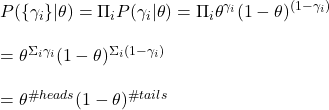
\\ P(\{\gamma_i\}|\theta) = \Pi_i P(\gamma_i|\theta) =  \Pi_i \theta^{\gamma_i} (1-\theta)^{(1-\gamma_i)}  \\ \\ = \theta^{\Sigma_i\gamma_i} (1-\theta)^{\Sigma_i(1-\gamma_i)} \\ \\ = \theta^{\#heads} (1-\theta)^{\#tails}

The calculations

1. Uniform prior: The prior probability of the Bayes equation is also known as belief. In the first case, we do not have any certainty regarding the bias. Therefore, we assume all values for theta (the parameter) are possible as the prior belief.

theta <- seq(0,1,length = 1001)
ptheta <- c(0,rep(1,999),0)
ptheta <- ptheta / sum(ptheta)

D_data <- c(rep(0,8), rep(1,2))
zz <- sum(D_data)
nn <- length(D_data)

pData_theta <- theta^zz *(1-theta)^(nn-zz)

pData <- sum(pData_theta*ptheta)

ptheta_Data <- pData_theta*ptheta/pData

2. Narrow prior: Suppose we have high certainty about the bias. We think that is between 0.4 to 0.6. And we repeat the process,

theta <- seq(0,1,length = 1001)
ptheta <- dnorm(theta, 0.5, 0.1)

D_data <- c(rep(0,8), rep(1,2))
zz <- sum(D_data)
nn <- length(D_data)

pData_theta <- theta^zz *(1-theta)^(nn-zz)

pData <- sum(pData_theta*ptheta)

ptheta_Data <- pData_theta*ptheta/pData
In summary

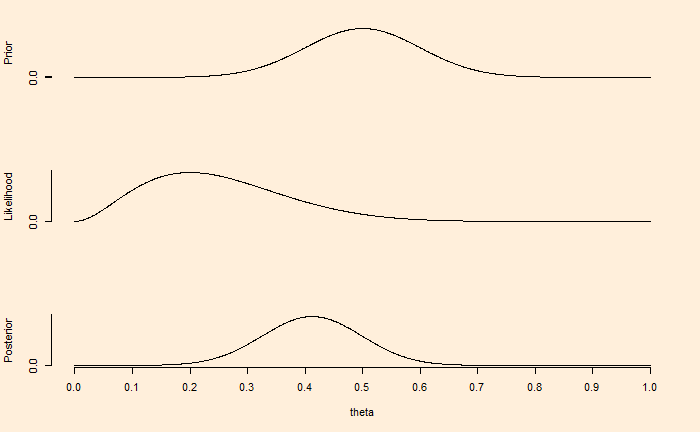
The first figure demonstrates that if we have a weak knowledge of the prior, reflected in the broader spread of credibility or the parameter values, the posterior or the updated belief moves towards the gathered evidence (eight tails and two heads) within a few experiments (10 flips).

On the other hand, the prior in the second figure reflects certainty, which may have been due to previous knowledge. In such cases, contradictory data from a few flips is not adequate to move the posterior towards it.

But what happens if we collect a lot of data? We’ll see next.

Bias in a Coin – Impact of Prior Read More »
Exaggerated State of the Union

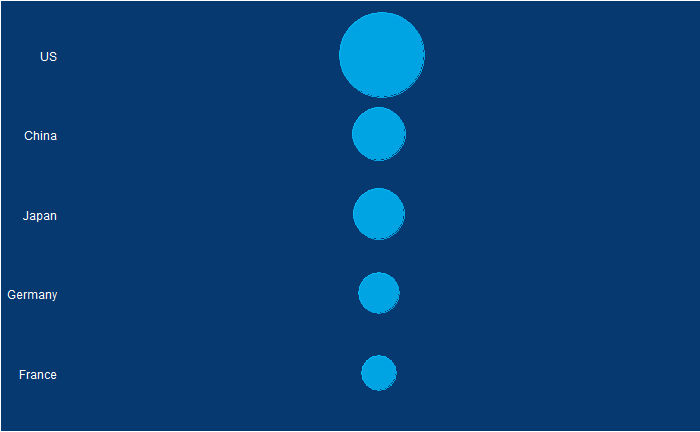
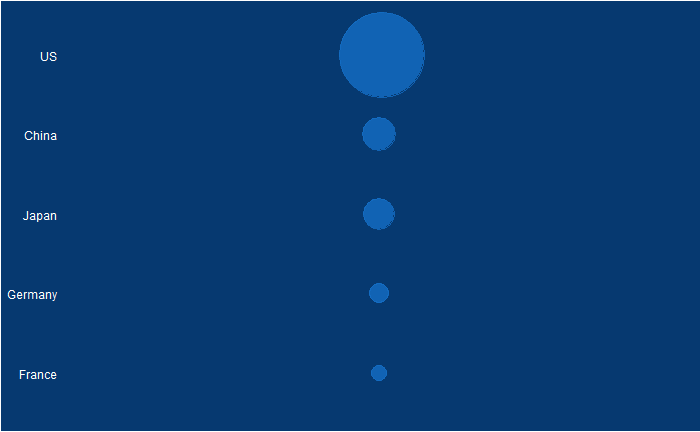
Political pitches are notorious for exaggerating facts. One example is the 2011 state of the union address of then-US President Obama. Here, he created a visual illusion using a bubble plot in the following form to represent how America’s economy compared with the rest of the top 4. Note what follows here is not the exact plot he showed but something I reproduced using those data.

Doesn’t it look fantastic? The actual values of GDP of the top 5 in 2010 were:

CountryGDP
(trillion USD)
US14.6
China5.7
Japan5.3
Germany3.3
France2.5

The president used bubble radii to scale the GDP numbers, which is not an elegant style of representation. It is because the area of the circle and the perspective it creates for the viewer squares with the radius. In other words, if the radius is three times, the area becomes nine times.

What would have been a better choice was to use the radius for scaling the bubble.

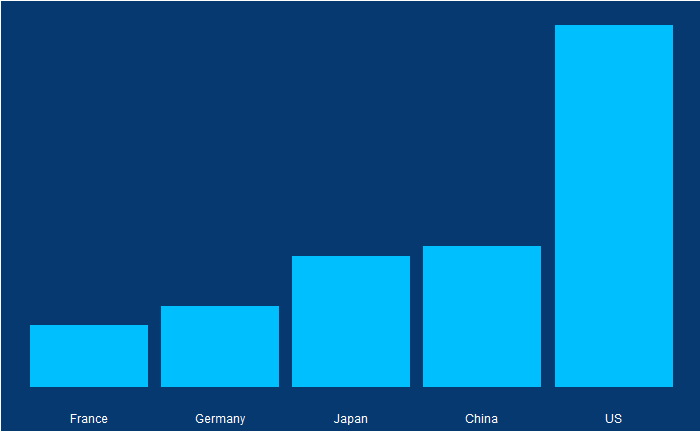
Or use a barplot.

Reference

The 2011 State of the Union Address: Youtube (pull up to 14:25 for the plot)

Exaggerated State of the Union Read More »

Principal Agent Problem

The principal-agent problem is a key concept in economic theory, which has some fascinating consequences in real life. It is easier to understand the idea using the following example.

You want to buy a house. There are a lot of potential sellers in the market; you meet one of them, agree on a price and settle the deal – a simple transaction between a buyer and a seller. But real life is more complex. You may not know where those sellers are, the market value or the paperwork that may be required to complete the process etc. So you approach a real estate agent, who has more knowledge in this topic than you, the principal. In technical language, an asymmetry of information exists.

The agent knows something that you don’t. And she realises the value (say, buy the best house at the cheapest rate) on the principal’s behalf.

A far more complex principal-agent dynamics work in a large company. A simple owner-household transaction becomes a series of relationships between the owner (shareholders) – board, board-CEO, CEO-top management, manager – technical expert etc. Here, the lower-down person (in the hierarchy) needs to act to realise the values and visions of the higher.

So what’s the problem?

The biggest one is trust. Ideally, you want the incentives of both parties (the principal and the agent) to be aligned. But since the agent has more knowledge, you suspect the former to misuse the information asymmetry to her advantage. It leads to a conflict of incentives, and the principal can’t make it if the agent did a good deal or a bad deal on your behalf.

Principal Agent Problem Read More »

The Data that Speaks – Final Episode

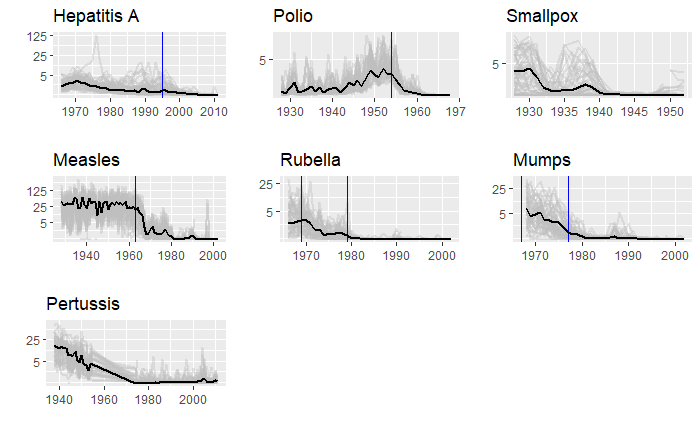
We will end this series on vaccine data with this final post. We will use the whole dataset and map how disease rates changed after introducing the corresponding vaccines. The function, ‘ggarrange’ from the library ‘ggpubr‘ helps to combine the individual plots into one.

library(dslabs)
library(tidyverse)
library(ggpubr)

We have used years corresponding to the introduction of vaccines or sometimes the year of licencing. In Rubella and Mumps, lines corresponding to two different years are provided to coincide with the starting point and the start of nationwide campaigns.

The Data that Speaks – Final Episode Read More »

The Data that Speaks – Continued

We have seen how good visualisation helps communicate the impact of vaccination in combating contagious diseases. We went for the ’tiles’ format with the intensity of colour showing the infection counts. This time we will use traditional line plots but with modifications to highlight the impact. But first, the data.

library(dslabs)
library(tidyverse)

vac_data <- us_contagious_diseases
as_tibble(vac_data)

‘count’ represents the weekly reported number of the disease, and ‘weeks_reporting’ indicates how many weeks of the year the data was reported.
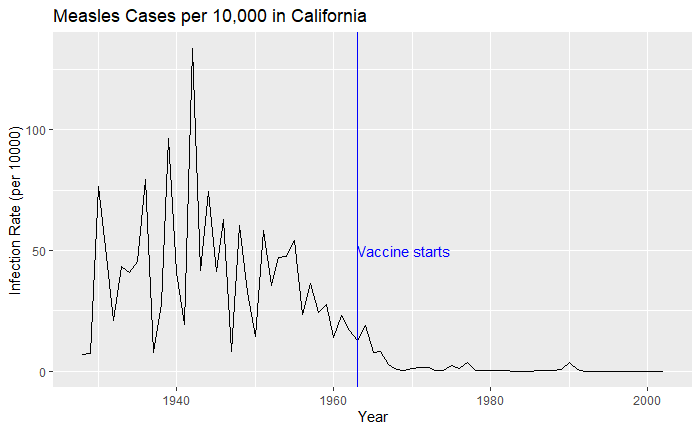
The total number of cases = count * 52 / weeks_reporting. After correcting for the state’s population, inf_rate = (total number of cases * 10000 / population) in the unit of infection rate per 10000. As an example, a plot of measles in California is,

vac_data %>% filter(disease == "Measles") %>% filter(state == "California") %>% 
  ggplot(aes(year, inf_rate)) +
  geom_line()

Extending to all states,


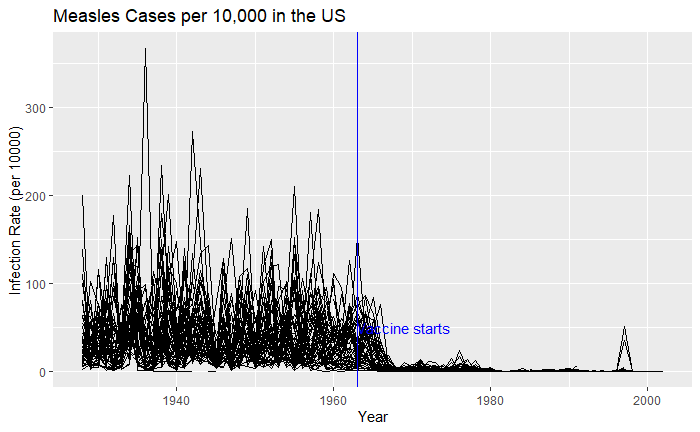
vac_data %>% filter(disease == "Measles") %>% ggplot() + 
  geom_line(aes(year, inf_rate, group = state)) 

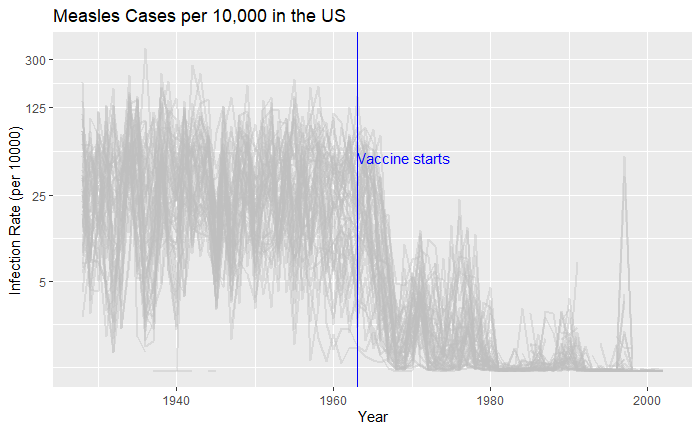
Nice, but messy, and therefore, we will work on the aesthetic a bit. First, let’s exaggerate the y-axis to give more prominence to the infection rate changes. So, transform the axis to “pseudo_log”. Then we reduce the intensity of the lines by making them grey and reducing alpha to make it semi-transparent.


vac_data %>% filter(disease == "Measles") %>% ggplot() + 
  geom_line(aes(year, inf_rate, group = state), color = "grey", alpha = 0.4, size = 1) +
  xlab("Year") + ylab("Infection Rate (per 10000)") + ggtitle("Measles Cases per 10,000 in the US") +
  geom_vline(xintercept = 1963, col ="blue") +
  geom_text(data = data.frame(x = 1969, y = 50), mapping = aes(x, y, label="Vaccine starts"), color="blue") + 
  scale_y_continuous(trans = "pseudo_log", breaks = c(5, 25, 125, 300)) 

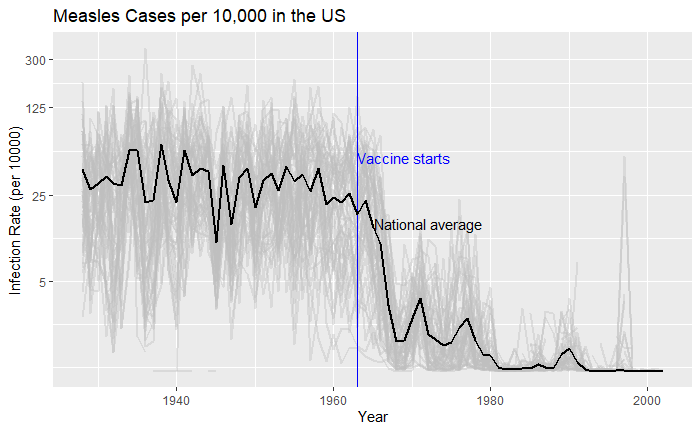
What about providing guidance with a line on the country average?

avg <- vac_data %>% filter(disease == "Measles") %>% group_by(year)  %>% summarize(us_rate = sum(count, na.rm = TRUE) / sum(population, na.rm = TRUE) * 10000)

geom_line(aes(year, us_rate),  data = avg, size = 1)

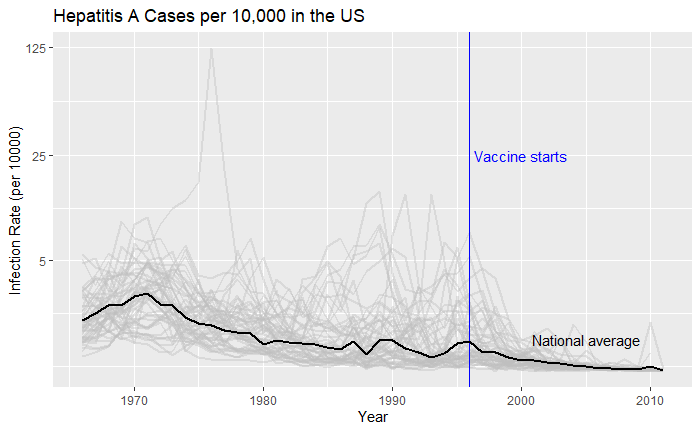
Doesn’t it look cool? The same thing for Hepatitis A is:

The Data that Speaks – Continued Read More »

The Data that Speaks

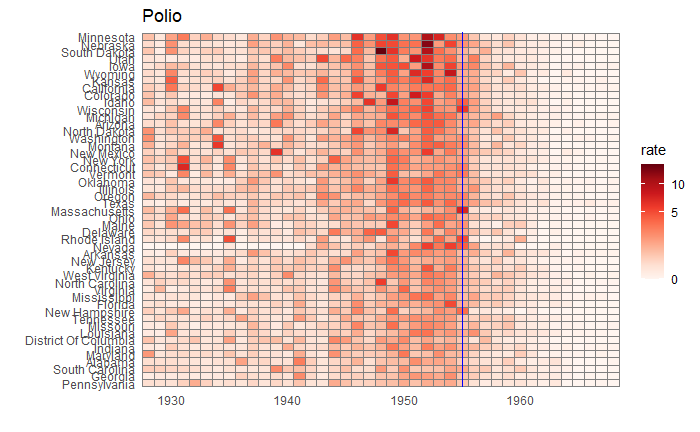
Vaccination is a cheap and effective way of combating many infectious diseases. While it has saved millions of people around the world, vaccine sceptics also emerged, often using unscientific claims or conspiracy theories. This calls for extra efforts from the scientific community in fighting against misinformation. Today, we use a few R-based visualisation techniques to communicate the impact of vaccination programs in the US in the fight against diseases.

We use data compiled by the Tycho project on the US states available with the dslabs package.


library(dslabs)
library(tidyverse)
library(RColorBrewer)

vac_data <- us_contagious_diseases

the_disease = "Polio"
vac_data <- vac_data %>%  filter(disease == the_disease & !state%in%c("Hawaii","Alaska")) %>% 
  mutate(rate = count / population * 10000) %>% 
  mutate(state = reorder(state, rate))


vac_data %>% ggplot(aes(year, state, fill = rate)) + 
  geom_tile(color = "grey50") + 
  scale_x_continuous(expand=c(0,0)) + 
  scale_fill_gradientn(colors = brewer.pal(9, "Reds"), trans = "sqrt") + 
  geom_vline(xintercept = 1955, col ="blue") +
  theme_minimal() + 
  theme(panel.grid = element_blank()) + 
  ggtitle(the_disease) + 
  ylab("") + 
  xlab("")

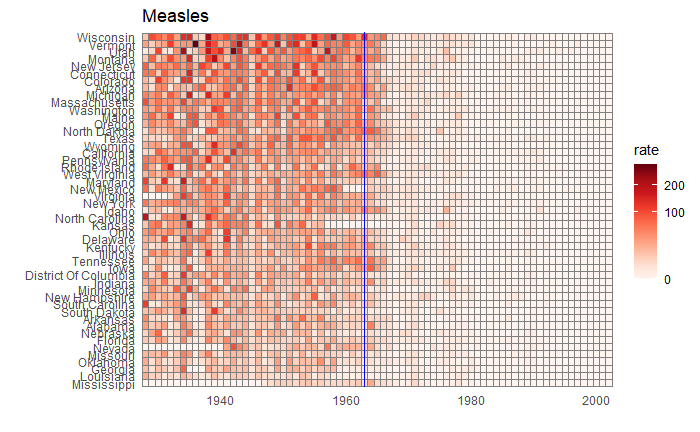
Now, changing the disease to measles and the start of vaccination to 1963, we get the following plot.

The Data that Speaks Read More »

Speed Matters

Another example to trouble your system 1, a.k.a. intuitive thinking and a version of the mileage paradox. It seems even Einstein found this riddle interesting!

I have to cover a distance of 2 kilometres. I did the first kilometre at 15 km/h (km. per hour). What speed should I maintain in the next one kilometre to cover the total distance at an average speed of 30 km/h?  

System 2 thinking

You may require a pen a paper to solve this puzzle. Take the first part: how much time does it take to cover one km at 15 km/h? The answer is 60/15 = 4 min. The second part, time to cover two km at 30 km/h: 60 mins for 30 km, 2 mins for 1 km or 4 mins for 2 km. But you already consumed 4 mins in the first one km!

So I can’t achieve the target; was it obvious the first time you heard the problem?

Speed Matters Read More »

Looking for Rules that Don’t Exists

The following is a riddle that used to make rounds on the internet: I have 50, then I spend it in the following way.

SpendBalance
2030
1515
96
60
Total spend
= 50
Total balance
= 51

The total spend is 50, and the total balance is 51 – how to explain the extra 1?

The riddle has intrigued a lot of people. But the answer is: no rule requires matching the sum of spend with the sum of the balance! Take this extreme example: I have 50, and I spent it fully.

SpendBalance
500
Total spend
= 50
Total balance
= 0

This time there is not much effort required for the mind to get convinced.

Looking for Rules that Don’t Exists Read More »

The Great wall and the moon

Seeing the great wall of China from the moon is an example of an urban myth. Interestingly, the story goes back to a 1932 cartoon that proclaimed “the only one that would be visible to the human eye from the moon”. Yes, 37 years before the first human landing on the moon happened!

As per the NASA website, the wall is generally not visible to the unaided eye even in low Earth orbit, let alone from the moon’s surface. At the same time, some of the other human-made landmarks are visible from low orbits. A key reason for this invisibility is that the texture of the material used to build the wall is similar to the surrounding landscape.

The Great wall and the moon Read More »

Tu Quoque Fallacy 

Can a smoker advise another one about the benefits of quitting smoking? Or can a leader insist on masking without wearing a mask?

It is the essence of the Tu Quoque (“you too”) fallacy. It involves treating an argument as invalid because you retort that the person who made the affirmation herself doesn’t follow it.

You may recognise the well-known idiom, “practice what you preach.” Hypocrisy may indeed be called out, but that does not make facts incorrect.

Another logical fallacy that is closer to this is Whataboutism. The key difference here is that the person who receives the criticism points to someone else who is not necessarily the person who delivered the original criticism. It is like saying, ” But the other group also did something similar” to justify one’s own mistake.

Tu Quoque Fallacy  Read More »