Decision Making

When a parasite can make you macho

What controls a person’s behaviour? Humans always seem to have some answers to this question. Historically, and still is the case for a large portion of humanity, it has been attributed to some types of divine power. At some stage, people, especially poets, thought it was the heart that controls humans; listen to your heart, they said! As science has progressed, the importance of the brain to our existence came in, and now the scientific community knows how the brain, and chemicals called hormones, can make a person. There is a new entrant to this list – parasites!

Parasite cheerleaders

The impact of Toxoplasma gondii, a protozoan parasite, on species has been the subject of several studies over the years. Past experimental studies have shown that infections can raise dopamine and testosterone production. All it requires for a parasite is to make a cyst at the right place, i.e. the brain. And can cause increased aggression and risk-taking behaviour, failure to avoid olfactory predator cues (i.e., seeking out instead of avoiding felid urine), and decreased neophobia (fear of novel food).

T. gondii in wolf’s clothing

A recent article by Meyer et al. in Communications Biology is another example, this time about the behaviour of wolves infected with the parasite. And they had 26 years of serological and observational data.

The researchers looked for three parameters of risk-taking: 1) leaving the pack, 2) getting dominant social status, and 3) approaching people and vehicles, and two causes of death: 1) death from other wolves and 2) death from humans.

The study has shown that the parasite has influenced the behaviour of wolves. The researchers identified an increase in the odds of dispersal and becoming a pack leader in wolves seropositive for T gondii.

References

Meyer et al., 5 (1180), 2022: Communications Biology
Parasite gives wolves what it takes to be pack leaders: Nature
Fatal attraction in rats infected with Toxoplasma gondii: Proc Biol Sci.

When a parasite can make you macho Read More »

The Mere-Exposure Effect

We will discuss a cognitive preference that can impact our decision-making. The mere-exposure effect, also known as the familiarity principle, is the human tendency to prefer what is familiar to us and to make us allergic to changes. As per the Encyclopedia of Social Psychology, it is “a phenomenon that simply encountering a stimulus repeatedly somehow makes one like it more”.

One direct application of this effect is in the area of advertisements. Marketing people have used this technique to perfection for brands and products through repeated campaigns to encourage customers towards them.

References

Mere-exposure effect: Wiki
Mere exposure effect: Encyclopedia of Social Psychology

The Mere-Exposure Effect Read More »

Carbon Price – Carbon Contracts for Difference

We saw last time in the En-ROADS simulation results the power of carbon price to make a difference in the decarbonisation pursuit. From the results, you can see what a carbon price of 200 $/tone of CO2 can do to the energy mix:

At that price, a whole set of renewable investment options is available to an investor. And only after such investment does the change happen. But that is not enough for someone to set billions of dollars in renewable projects. The magic word is uncertain. How could an investor trust the carbon price at a future date to be true? What happens if the governments backtrack from today’s commitments or remove schemes (say, cap and trade) altogether? So the political uncertainty for an investor is too high to depend on the carbon price.

CCFD – the hedge against uncertainty

One way to reduce the uncertainty and encourage investments in clean energy is a carbon contract for difference (CCFD). CCFD is the commitment by the government to pay out to companies a specified amount of money in case there is a difference between the expected and the actual.

References

The Paris Agreement: UNFCCC

EN-ROADS: Climate Interactive

Carbon Price – Carbon Contracts for Difference Read More »

Jevons Paradox

Jevons paradox is a term associated with behavioural economics in which one, often a policymaker, expects a substantial decrease in energy consumption by replacing a lower efficiency unit with a higher one, instead finding only a marginal drop, or worse, an increase. It is also sometimes called the rebound effect.

Mexico’s C4C program

An example is a study by Davis et al. on the Cash for Coolers (C4C) program that ran in Mexico. C4C was a large-scale replacement program started in 2009 that helped ca. 1.5 million households to replace old refrigerators and air coolers with new energy-efficient (> 5% from the 2002 standard) ones. In return, the household can get up to $185 in subsidies.

A World Bank study, for example, estimated a savings of 481 kWh/y from the change out of refrigerators. In reality, Davis’ study found that the real benefit was about 11 kWh per month which translated to 11 x 12 = 132 kW/y, just over a quarter of what was originally envisaged.

Increased consumption from coolers

The air conditioner story was even more dramatic. After the substitution with the more energy-efficient ones, the overall energy consumption increased!

There can be different explanations for what happened. But one thing is clear – the implementor had made inaccurate assumptions about consumer behaviour. It is possible that in the process, the household got a chance to turn in some of the old, unused appliances in return for a subsidised new one.

Jevons Paradox Read More »

The Happiness Formula – Experience vs Memory

We started this blog stating that the “Thoughtful Examinations” was about life, knowledge, and happiness, yet we have spent the least amount of time, so far, on the topic of happiness, but not today. Let us start with a question: what causes happiness?

Before answering the question, we will briefly consider the two kinds of experiences of happiness. As per Nobel laureate Daniel Kahneman, they are the experiencing self and remembering self. The former is about joy, or the pain someone undergoes at a given moment, and the latter is about how she remembers it later.

Kahneman’s team conducted an experiment in which he collected data from 682 patients undergoing the colonoscopy process. As you may know, a colonoscopy is not a pleasant experience. It was a randomised control test (RCT) in which the group was divided into two – the first group was called the normal, and the second was the modified.

Adding a minute of happiness

For the normal group, it was the standard colonoscopic procedure, whereas, for the modified group, the researchers added a few minutes of a non-pharmacologic intervention by extending the duration with lessened pain to the patient. The tip of the colonoscope was allowed to rest in the rectum for about 3 minutes without any suction or inflation.

The assessment used the so-called Gottman–Levenson approach: the participants (patients who authorised the researchers to collect data) got a handheld device through which one can mark the extent of pain at regular intervals, from no pain (score = 0) to extreme pain (score = 10).

The end makes a difference

The study results were evaluated on two parameters – the patient’s feedback to a questionnaire and the rate of return for a follow-up colonoscopy. The questionnaire was a retrospective evaluation of how a participant felt about the procedure. The results were significantly different from each other. The patients who received the modified treatment remembered the whole event as less painful, although the beginning, the middle part and the peak pains were comparable to both groups.

The Happiness Formula – Experience vs Memory Read More »

The Myside Bias

The last few posts covered one important aspect of our irrationality. That it is beyond the education level or other types of cognitive deficiencies, but purely ideological. The author Steven Pinker calls it the myside bias.

The Myside Bias Read More »

Partisan Bias

Who is more biased in US politics – democrats or republicans? The answer is – democrats think it’s the republicans, and the republicans think it’s the Democrats! This is what is known as partisan bias, in which the person or group of a particular political view act, interpret or promotes ideas that align with their ideological background.

There is a notion in political psychology which proposes that it is the conservatives that possess more bias in their view owing to their inability to update with changes that go around in the world. It led to the school of asymmetric partisan bias theory.

Ditto and coworkers (2019) did a meta-analysis of 51 experimental studies on the partisan bias. The studies included topics ranging from environmental to gun control, welfare to abortion. Interestingly, most of the study results showed overall biases with r values in the range of 0.2 – 0.3, which we know from an earlier post, is close to randomness. Naturally, the difference of r values between liberals and conservatives was also close to zero.

Partisan Bias Read More »

Motivated Reasoning – Climate Change

The irrationality of the public on subjects of global impacts, such as climate change, has been explained using three dominant theories. They are 1) the scientific illiteracy theory, 2) the bounded rationality theory, and 3) the cultural cognition theory. The first assumes that most people lack the science education to understand the complex nature of global warming. The second one goes hand in hand with Kahneman’s definition of system 1 (fast) and system 2 (slow) thinking. The third one concerns the perception of risks and how they fit with an individual’s value systems.

To apply this to climate change: a familiar narrative is that the average public lacks the capacity to comprehend the science behind it and therefore resorts to some form of heuristics to understand, which is often governed by her beliefs. The name associated with this portrayal is the public irrationality thesis (PIT).

Application to climate change

Kahan et al. have applied the theory to testing. Contrary to the expectation, in his first test (N = 1540), he found that increased science literacy and numeracy did not increase the risk perception of climate change; in fact, it slightly decreased!

On the other hand, the study found that an egalitarian individual (communitarian) is more likely to have a higher risk perception of climate than a hierarchical person (individualist). It remained the same or slightly increased with her numeracy. It was striking that the hierarchical individualist did not progress her risk perception as a function of numeracy; instead, it slightly reduced!

Nuclear risk

On the other hand, to answer the question about the impact of nuclear power on human health and safety, both types of individuals showed reduced perceived risks as a function of their literacy.

Beliefs over rationality

Both these data suggest that increasing science education and numeracy is not necessarily to help detach oneself from her beliefs.

Motivated Reasoning – Climate Change Read More »

Motivated Reasoning

When there are scientific data, why do people still debate? This was one fundamental question that attracted the attention of scientists and sociologists.

From education levels to ideology

There are multiple hypotheses on this topic. One suggests that the ability to interpret data, such as numerical abilities, is a predictor of people’s understanding of scientific studies. The other was about the ideological biases of people.

One study was carried out by Kahan et al., who selected 1111 US adults from diverse backgrounds. Their composition was summarised in the following tables. Two sets of problems are used – one was ideologically neutral (the skin rash problem), and the other was sensitive (the gun possession problem).

The skin cream problem

Rash got
worse
Rash got
better
Patients who
used cream
22375
Patients who
did not use cream
10721

Rash got
better
Rash got
worse
Patients who
used cream
22375
Patients who
did not use cream
10721

The hypothesis formed here was that the individuals holding higher numeracy to score right results in the skin care problem. It turned out to be true – the people with higher cognitive abilities interpreted the results correctly. There was no real pattern suggesting a dependence on whether the subject was a Democrat or a Republican.

The gun control problem

Increase
in Crime
Decrease
in Crime
Cities that banned
concealed
guns in public
22375
Cities that banned
concealed
guns in public
10721

Decrease
in Crime
Increase
in Crime
Cities that banned
concealed
guns in public
22375
Cities that banned
concealed
guns in public
10721

But the pattern of gun control was different. It was not the numeracy that dominated the outcome but the ideology. The liberals increasingly corrected identified results that supported their view – crime decreases with gun control. And almost a complete shun to the crime increases scenario.

Conservatives, on the other hand, increasingly ‘understood’ (as a function of their numeracy) the crime-increased-by-gun-control data but ignored the opposite results.

Motivated Reasoning Read More »

LNN for Pareto Distribution

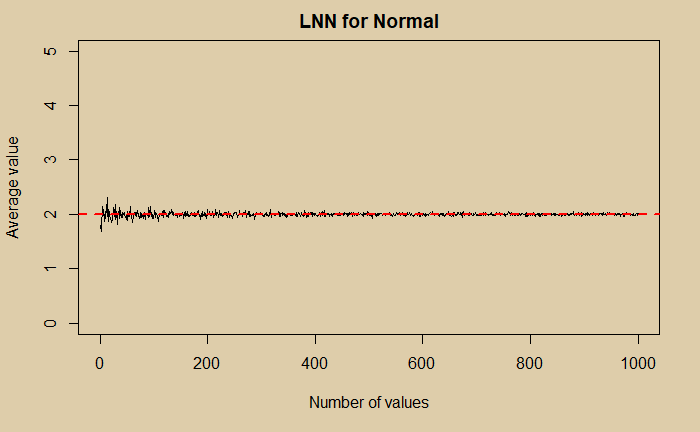
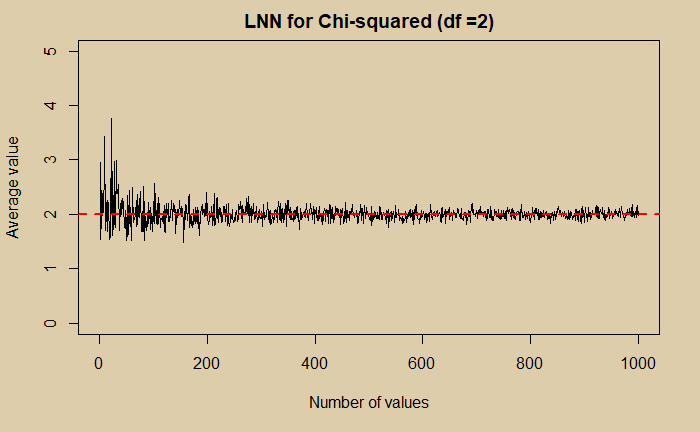
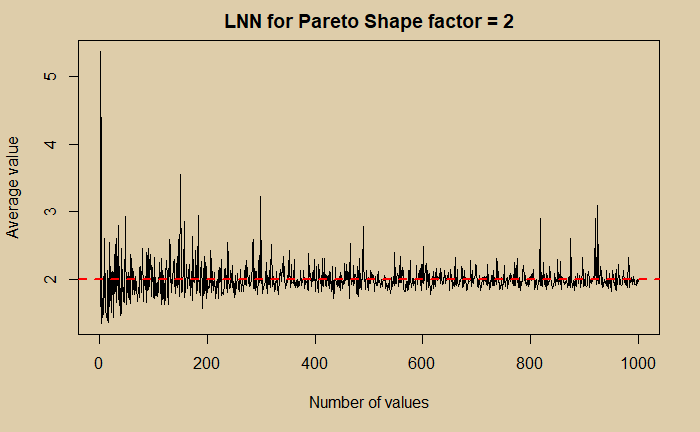
We have seen how different distributions converge to Gaussian, which is one fundamental property of statistics known as the central limit theorem (CLT). The second all-important property is the Law of Large Numbers (LNN). The following three plots show how that happens.

LNN for Pareto Distribution Read More »