Decision Making

Hypothesis Tests – What to Use

We have seen several hypothesis testing methods, such as t-tests, Z-tests, ANOVA etc. Today, we will build a flowchart to help decide what to choose. Before we select, there are a few conditions that we must satisfy.

1) We have a random sample. In case you forgot, a sample is a collection of observations. If all members are inside it, you no longer call it a sample but a population. So, the first condition says the observations must be unbiased.
2) We focus on continuous data this time.
3) The sample data should follow a normal distribution. If not, have more than 30 observations and let the central limit theorem justify you.

What is a paired sample?

Paired samples are observations on the same set of individuals, e.g. before and after or pre-intervention and post-intervention.

Hypothesis Tests – What to Use Read More »

Coin Flipping Game

Anna and Bryce are playing a game of coin flips. Anna gets one point for a head, and Bryce gets one for a tail. Whoever secures 10 points win the game. At present, Anna leads 8 – 7. What is the probability that she eventually wins?

The maximum number of games possible from now is four (a best of 19 will lead to 10, and 15 games are over). The simplest solution is to list all the possibilities that favour Anna and estimate the probabilities of those occurrences. They are

OutcomeProbability
HH 1/4
HTH 1/8
HTTH1/16
THH 1/8
TTHH1/16
THTH1/16
Total11/16 = 0.6875

Coin Flipping Game Read More »

It’s Raining Dice

Back to dice. Your friend casts two dice and tells you that at least one of them is a six. What is the probability that both of them are sixes?

We use Bayes’ theorem first.

P(B6|A6) = \frac{P(A6|B6)*P(B6)}{P(A6|B6)*P(B6) + P(A6|F6)*P(F6) + P(A6|S6)*P(S6) + P(A6|N6)*P(N6)}

P(B6|A6) – Probability of both six, given at least one is a six.
P(A6|B6) – Probability at least one is a six given both are six = 1
P(B6) – Prior probability for both of them is six = 1/36.
P(A6|F6) – Probability at least one is a six, given the first die is a six (and the second is not) = 1
P(F6) – Prior probability of the first die is a six (and the second is not) = (1/6)x(5/6).
P(A6|S6) – Probability at least one is a six, given the second die is a six (and the first is not) = 1
P(S6) – Prior probability of the second die is a six (and the first is not) = (1/6)x(5/6).
P(A6|N6) – Probability at least one is a six given none is size = 0
P(N6) – Prior probability of none is a six = (5/6)x(5/6).

P(B6|A6) = \frac{\frac{1}{36}}{\frac{1}{36} + \frac{5}{36} + \frac{5}{36} + 0} = \frac{1}{11}

If you are not convinced, here is a pictorial explanation:

Here are all the pairs that include at least one of them as a six. There are 11 of them in total. And there is only one that is both six. So the probability is 1 in 11.

It’s Raining Dice Read More »

Fourfold Pattern of Decision Making

In prospect theory, we have seen how human psychology slips into irrationality while understanding risks. The fourfold pattern is one such representation; of behaviours that deal with extreme probability events.

Imagine the following four cases of improving the chances of making one mln dollars.
A. 0% to 5%
B. 5% to 10%
C. 50 to 55%
D. 95 to 100%

A robot will perform the following calculations and conclude

A. (0.05 x 1,000,000 + 0.95 x 0) – 0 = $50,000
B. (0.1 x 1,000,000 + 0.90 x 0) – (0.05 x 1,000,000 + 0.95 x 0) = $50,000
C. (0.55 x 1,000,000 + 0.45 x 0) – (0.5 x 1,000,000 + 0.5 x 0) = $50,000
D. (1.0 x 1,000,000 + 0.0 x 0) – (0.95 x 1,000,000 + 0.05 x 0) = $50,000

that, all those situations lead to the same outcome – the robot has just performed an expected value calculation! But humans are not robots, and not all increment (wins or losses) has the same value.

A change from 0% to 5% is a movement from impossibility to a ray of hope. And that triggers the brain disproportionally. In other words, we overestimate that 5%. A classic example is a lottery ticket. How many of us would buy a ticket that expired a month ago? In reality, the chance of winning a lottery is almost the same as that of an expired one! This behaviour is called ‘risk-seeking‘.

On the other hand, progress from 95% to 100% is a change from possibility to certainty. An example is an out-of-court settlement. Assume you have a 95% chance of winning a lawsuit at $1 mln. Your lawyer indicated a 5% chance of losing the case and conveyed the other party’s willingness for a settlement of %750,000. Will you take it? This is ‘risk aversion‘ or underestimation of probability.

Fourfold Pattern of Decision Making Read More »

Game Theory of Marks

This one is picked from the Internet and attributed to a University of Maryland professor. The students have the opportunity to get extra marks. They can select 6 or 2 points, but with conditions: if more than 10% of the students choose 6, no one gets anything. What will be your choice?

Others pick
6 points
Your
Pick
> 10%< 10%
2 Points02
6 points06

So, in either case, you are better off or at least as good off by picking 6.

Game Theory of Marks Read More »

Probability of New Boy

Let’s visit our favourite subject, but after a long gap – the probability and Bayes’ theorem. Here is the question:

A new child arrives in a child-care facility that has three boys and the remaining girls. A statistician visits the centre and randomly picks up a boy child. What is the chance that the newly admitted child is a boy?

Before solving the puzzle, let the number of girls already in the centre be g. Therefore, the total number of children available for the statistician to count is 3 + 1 + g = 4 + g.

The Bayes’ equation is

P(B_n | B_r) = \frac{P(B_r | B_n) * P(B_n)}{P(B_r | B_n) * P(B_n) + P(B_r | G_n) * P(G_n)}

The terms are
P(B_n | B_r) = probability of the new child being a boy given the randomly picked is a boy
P(B_r | B_n) = probability of picking a random boy given the new child is a boy = 4 /(4+g)
P(B_r | G_n) = probability of picking a random boy given the new child is a girl = 3/ (4+g)
P(B_n) = prior probability for the new child to be a boy = 0.5
P(G_n) = prior probability for the new child to be a girl = 0.5

Substituting the terms,

P(B_n | B_r) = \frac{\frac{4}{4+g}*0.5}{\frac{4}{4+g}*0.5 + \frac{3}{4+g}*0.5} = \frac{4}{7} = 57.14\%

Probability of New Boy Read More »

Prospect Theory – Better safe than sorry

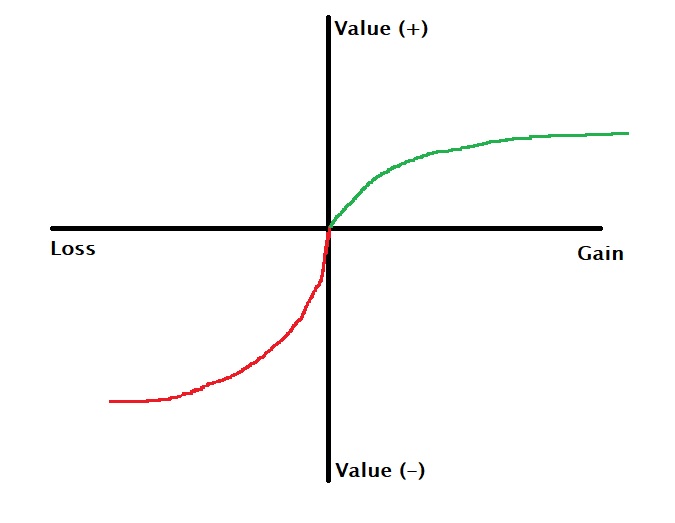
Prospect theory is a behavioural model which explains how people make decisions that involve risk. It has been observed that people take gains and losses differently. In short, to the decision maker, the pain of losing something scores higher over the pleasure of gaining – the risk aversion.

The plot below illustrates the prospect theory. While both the positive side (green part) and the negative side (red part) reflect diminishing marginal utility (flattening towards the higher x values), the initial few gains and losses have distinct shapes. Imagine the feeling you have when you get 100 dollars; compare that with gaining an additional hundred dollars, say from 2000 to 2100.

The fundamental question here is: what defines the origin of the plot? One possibility is that it represents the present state. I can also argue it marks the expectations. An example of the latter is the famous case of silver medal winners. Studies seem to indicate that the second-place winners of sports events were unhappier than the third-place holders, especially when it is contrary to prior expectations.

Daniel Kahneman and Amos Tversky; Econometrica, 47(2), 1979, 263-291
McGraw et al.; Journal of Experimental Social Psychology 41, 2005, 438–446

Prospect Theory – Better safe than sorry Read More »

What Happened in Fukushima

The nuclear event in Fukushima started with the Tohuku earthquake and the subsequent tsunami in 2011. It was interesting to notice that employing a probabilistic risk assessment (PRA) would have resulted in a decent chance for station backout due to tsunami (5%) and should have been factored into the decision-making process. Now let’s look at the technical details of what happened.

What happened?
The tsunami of 2011 resulted in the flooding of the low-lying blocks of the reactor buildings, and that caused system backout (main and electrical power and the Emergency diesel generators). This contributed to a lack of cooling and, thereby, the reactor melting. The cladding material of the fule rode is made of Zirconium (Zr), and at elevated temperatures, Zr reacted with water leading to the production of hydrogen and explosions. The end result was damage to the fuel core and a release of fission products, including the radioactive I and Cs.

What Happened in Fukushima Read More »

Confounding and Bubble Creation

We have used the assumptions of independence and randomness of variables while forming the theoretical foundations of statistical analysis. Real-life conditions are more complex, and we have encountered situations wherein these premises go out of the window due to hidden confounding factors. One such – a very costly – example is the financial meltdown of 2008.

To understand the crisis of 2008, you need to understand what is known as mortgage bonds. These are packages of basically mortgages that an investment bank floats (secured from commercial banks that had lent to their customers). These share-like entities are now available to investors to buy. To cut the story short: once an investor buys a unit, she buys a portion of all the mortgages in that “special purpose entity”. Now, the assumptions regarding the strength of these bonds, e.g. a highly rated unit.

A seller promises two things within an AAA-rated package – the most trustworthy (high credit rating) borrowers and independence of default. When an investment bank informs you that they have bunched five mortgages into a pool and will pay you unless all the mortgages default. They made you believe the following,

1) Each of them has the lowest probability of failure because of the AAA rating
2) One mortgage failure does not impact the chances of the second – the assumption of independence.

These packages of mortgages may have names such as mortgage-backed securities (MBS) or collateralized debt obligations (CDO), depending on the exact composition of what is inside.

So, what’s wrong?

Suppose each of the units inside the pack has a default chance of 0.05 (5%); if you assume independence, the probability of everything defaulting becomes 0.055 = 0.0000003125 (0.00003%) – a negligible prospect. But what if the risks are perfectly aligned? Then a 5% chance will make all of them collapse. Suddenly, the 0.00003% becomes 160,000 -fold to 5%. On top of this, what if the credit agency erred in their estimate of 5% default risk, which was 10 or 20 per cent? The result caused the perfect storm of 2008.

MDS and CDO: Investopedia

2008 Housing Bubble: New Money

Confounding and Bubble Creation Read More »

T. gondii Continues

The previous post that a parasite triggers wolves to become courageous leaders may sound fantastic, but something difficult to accept as a fact. If you recall rule number one of statistics: “correlations are not causations”, you may realise that there could be other explanations to understand wolves’ the peculiar behaviour of some wolves who happened to have been infected.

What if the same behaviour, aggression, tendencies to walk out of the pack, and courage is the reason that caused the disease in the first place? The claim is not entirely without reason, as the animal gets the illness from cougars that share the same land space. After all, these are observational studies. Naturally, we would have liked to see results from a controlled study.

The researchers selected 64 laboratory rats and infected 32 of them (experimental group) with a cyst-forming strain of the parasite. The other 32 are given a placebo (control group). The rates were exposed to an area, and its corners contained distinct odours, representing four species – rat, cat, rabbit and neutral.

Now, a bit of evolution. Small mammals under heavy predation pressure evolved as species that could identify and avoid the presence of their predators. For rats, it is the ability to smell and avoid cats. You know already that it is not a rat that decided to build the capability to help itself; rather, as per the principle of survival of the fittest, only those rat species survived and had multitudes of offspring. Studies have shown that rats don’t lose the anti-predator behaviour (aversion to cat smell) even after hundreds of generations without having felt the presence of a cat.

And this is where our study got interesting. In the experiment, the status of the rats, infected or otherwise, did not change their movement towards the three non-cat selling areas. Whereas the uninfected rate disproportionally avoided cat-smelling spots compared to the infected.

References

T. gondii Continues Read More »