Decision Making

Arrangement Problems

The distribution of objects into boxes is a classical statistics question, which I find very hard to understand. For example, the number of ways a person can distribute 36 chocolates among five kids in which nobody gets fewer than 5.

Let’s start with the concept of arrangements as permutations of objects and partitions. How many ways to distribute n balls into k boxes when the balls are distinguishable, and the order doesn’t matter? The following picture illustrates this question for n = 5 and k = 5.

From the picture, you may envisage the problem as the arrangement of 5 different (distinguishable) coloured balls and four similar (indistinguishable) partitions — a set up of 9 objects. If you get this concept clear, life becomes simpler.

The total possible arrangements are nothing but a distribution of n + k – 1 objects with k -1 items that are similar. Mathematically it is

(n + k – 1)!/(k – 1)!

Naturally, if the balls are indistinguishable, you will have to divide the term with n!

(n + k – 1)!/[(k – 1)! n!]

And if you notice carefully, it is a combination, i.e., (n + k – 1)C(k – 1)

Arrangement Problems Read More »
Average of Percentages

A company tested two vaccines (V1 and V2) at two locations (L1 and L2) and got the following success rates.

L1L2
V180%70%
V275%60%

Which one is a better vaccine? V1, without a doubt, eh? Because V1 beats V2 at L1 as well as at L2. At an average of 75% for V1 vs 67.5% for V2. Unfortunately, we cannot conclude which is better until we know the sample sizes. Now, the sample sizes

L1L2
V1100900
V2900100

Leading to total success

L1L2Total
V180630710
V267560735

Leading to a success rate of 71% for V1 and 73.5% for V2. It is sometimes called Simpson’s paradox but is not a paradox. It is just a mistake for not paying attention to the format – percentage – of the result!

Average of Percentages Read More »

Smoking and Cancer

You tell me smoking causes lung cancer. I know several of my friends who smokes but never got cancer. How do you explain?

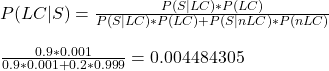
Suppose 90% of lung cancer patients are smokers and 20% of people with no lung cancer also smoke. What is the chance that a smoker has cancer? To estimate the answer, we should first know the probability of lung cancer in society. Suppose it is 0.1%.

\\ P(LC|S) = \frac{P(S|LC)*P(LC)}{P(S|LC)*P(LC) + P(S|nLC)*P(nLC)} \\ \\  \frac{0.9*0.001}{0.9*0.001 + 0.2*0.999} = 0.004484305

So, the probability of a random smoker having cancer is 0.44%. So what about non-smokers having lung cancer?

\\ P(LC|nS) = \frac{P(nS|LC)*P(LC)}{P(nS|LC)*P(LC) + P(nS|nLC)*P(nLC)} \\ \\  \frac{0.1*0.001}{0.1*0.001 + 0.8*0.999} =  0.0001251095

It is 0.013%. Therefore, a smoker is 0.44/0.013 = 35 times more likely to get cancer.

Smoking and Cancer Read More »

Probability of Cheat Coin

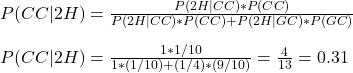
Anne has a bag with ten coins; one of them is a cheat coin (both side-heads). She picks up one coin and tosses it two times, and both are heads. What is the probability that she picked the cheat coin?

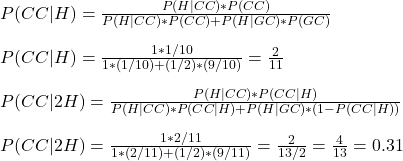
We all know that the probability of drawing the cheat coin from the bag is 1/10, but that was not the question here. It is on chance, given a piece of information is already available. So the ask must be an updated (Bayesian) guess. We can solve the problem in two ways.

Method 1: In one step

\\ P(CC|2H) = \frac{P(2H|CC)*P(CC)}{P(2H|CC)*P(CC) + P(2H|GC)*P(GC)} \\ \\ P(CC|2H) = \frac{1 * 1/10}{1 *(1/10) + (1/4)*(9/10)} = \frac{4}{13} = 0.31

Method 2: Posterior as the new prior

\\ P(CC|H) = \frac{P(H|CC)*P(CC)}{P(H|CC)*P(CC) + P(H|GC)*P(GC)} \\ \\ P(CC|H) = \frac{1 * 1/10}{1 *(1/10) + (1/2)*(9/10)} = \frac{2}{11}  \\ \\ P(CC|2H) = \frac{P(H|CC)*P(CC|H)}{P(H|CC)*P(CC|H) + P(H|GC)*(1-P(CC|H))} \\ \\ P(CC|2H) = \frac{1 * 2/11}{1 *(2/11) + (1/2)*(9/11)} = \frac{2}{13/2} = \frac{4}{13} = 0.31

The notations are:
P(CC|2H) = chance that it is a cheat coin, given two times heads
P(2H|CC) = chance of two heads for a cheat coin
P(CC) = the prior chance for a cheat coin
P(2H|GC) = chance of two heads for a good coin
P(GC) = the prior chance for a good coin= 1 – P(CC)
P(CC|H) = chance that it is a cheat coin, given heads in the first toss
P(H|CC) = chance of heads for a cheat coin
P(H|GC) = chance of heads for a good coin

Probability of Cheat Coin Read More »

Sheriff’s Dilemma

The Sheriff’s Dilemma is an example of a simultaneous move Bayesian game. In a standard game, the Nash equilibrium is formed by a player’s understanding of the other player. Whereas in Bayesian, the type (of the other) also matters. We will see that through an example. But before that, the rules.

Civilian vs criminal

The sheriff encounters an armed suspect, and they must decide whether to shoot at the other.

  1. The suspect could be a criminal with probability p and civilian with (1-p).
  2. The sheriff shoots if the suspect shoots
  3. The criminal always shoots

The payoffs are

civilian (1-p)sheriff
ShootNot
suspectShoot-3,-1-1,-2
Not -2,-10,0
criminal (p)sheriff
ShootNot
suspectShoot0,02,-2
Not -2,-1-1,1

Before moving to the sheriff, let’s find out the strategy of the suspect. If the suspect is a civilian, his dominant strategy is not to shoot (-2 > -3 AND 0 > -1). For the criminal, the dominant strategy is to shoot (0 > -2 AND 2 > -1).

The sheriff’s payoff

The expected payoffs if the sheriff shoots is = -1 x (1-p) + 0 x p = p – 1
The expected payoffs if the sheriff doesn’t shoot is = 0 x (1-p) -2 x p = -2p

So, the payoffs match for p = 1/3. If p is greater than 1/3, the sheriff is better off if he shoots.

Sheriff’s Dilemma Read More »

Penalty Kicks Continued

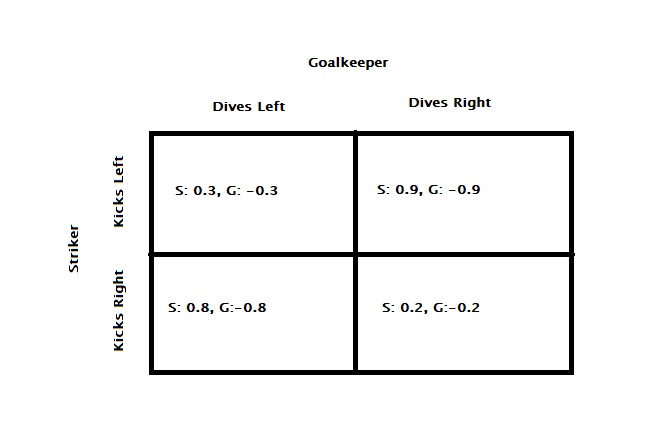
A quick recap: the striker has the option to kick to his left or right, and the goalie to dive likewise. The payoff matrix is:

The striker’s probability of shooting to the left is psand he aims to provide no incentive for the goalie to dive either to the left or right.

dive to left = dive to right
-0.3*ps -0.8*(1-ps) = -0.9*ps -0.2*(1-ps)
(-0.3 + 0.8 + 0.9 – 0.2)*ps = 0.8 – 0.2
ps = 0.6/1.2 = 0.5

The goalie’s probability of diving to the left is pg, and he aims to provide no incentive for the striker to shoot either to the left or right.

strike to left = strike to right
0.3*pg + 0.9*(1-pg) = 0.8*pg + 0.2*(1-pg)
(0.3 – 0.9 – 0.8 + 0.2)*pg = 0.2 – 0.9
pg = 0.7/1.2 = 0.58

The number of goals =
ps*pg*corresponding chance of a goal+
ps*(1-pg)*corresponding chance of a goal+
(1-ps)*pg*corresponding chance of a goal+
(1-ps)*(1-pg)*corresponding chance of a goal

The number of goals = 0.5*0.58*0.3 + 0.5*0.42*0.9 + 0.5*0.58*0.8 + 0.5*0.42*0.2 = 0.55

About a 55% chance of scoring a goal.

Penalty Kicks Continued Read More »

Penalty Kicks – Game Theory

It’s game theory time once again. Today, we’ll discuss strategic options available to layers while taking (and saving) football penalty kicks. In penalty kicks, the striker of the ball gets a chance to aim at the goal from about 11 m distance with only the goalkeeper to protect.

Since the reaction time is short, the goalkeeper must decide to judge the ball’s direction almost instantaneously, making the whole process a simultaneous game. Let’s build a payoff matrix reflecting such a game.

Before answering that question, we must know that the striker will randomise his shots, or it will hand a huge advantage over to the goalkeeper. And the goalie aims to make the striker indifferent to striking to the left vs the right. Then, find out the probability (for the goalkeeper to dive left) at which the striker’s payoffs are equal.

strike to left = strike to right

0.3*p + 0.9*(1-p) = 0.8*p + 0.2*(1-p)
(0.3 – 0.9 – 0.8 + 0.2)*p = 0.2 – 0.9
p = 0.7/1.2 = 0.58

The goalkeeper should try to dive left slightly more often. So, how many goals are expected in such a scenario? That is next.

Penalty Kicks – Game Theory Read More »

Battle of Sexes – Bayesian

You know the famous game-theory subject, the battle of the sexes. In a nutshell, it’s a game between A, who likes football and B, who prefers dance. But they also value each other’s company more than they dislike each other’s interests. Here is the overall payoff matrix written on the tastes.

B
FootballDance
AFootballA:10, B:5A:0, B:0
DanceA:0, B:0A:5, B:10

In the classical case, A and B have 100% certainty about what the other person likes. Imagine, A becomes moody a few days a month and wants to be alone on those days. So from B’s standpoint, she knows A could be in a bad mood but doesn’t know when. So she attaches a probability, p, for A’s state.

From the side of B, there is a chance p that A wants her company.

B
FootballDance
AFootballA:10, B:5A:0, B:0
DanceA:0, B:0A:5, B:10

And a chance (1-p) A doesn’t. And here is the corresponding payoff matrix.

B
FootballDance
AFootballA:0, B:5A:10, B:0
DanceA:5, B:0A:0, B:10

Such cases come under the category of Bayesian Nash Equilibrium. In the original Nash equilibrium case, a player does things based on what the other player will do. In the case of Bayesian, the player acts, given what she knows the other person could do.

Battle of Sexes – Bayesian Read More »

The Muller-Lyer illusion

Look at the above graphic. There are two lines terminated with either arrowheads or arrow tails. While the length of the lines in both cases is the same, the illusion created by the form of the terminals makes our brain believe that the one on the bottom is longer. This is the Muller-Lyer illusion.

The Muller-Lyer illusion Read More »

Wisdom of the Crowd and Winner’s Curse

The wisdom of the crowd is an idea that stems from the fact that the average estimation by a group of people is better than by individual experts. In other words, when a large group of non-experts (not biased by knowledge!) possessing diverse opinions starts predicting a quantity, their assessment tends to form a kind of bell curve – a large pack in the middle and outliers nicely distributed on either side.

In other words, the outlier of the crowd has a lower probability of estimating it accurately. Mark this line; we need it later.

Estimating the weight

Let’s go back to Francis Galton (1907) and the story of the prize-winning-ox. It was a competition in which a crowd of about 800 people participated to predict the weight of an ox after it had been slaughtered and dressed. The person whose prediction came closer would win the prize. On the event in which Galton participated, he found a nearly normal distribution of ‘votes’, and the middlemost value, the popular choice or the vox populi, was 1207 lb which was not far from the actual dressed weight of 1198 lb.

Bidding for the meat

Now, change the scenario: the winner is no longer the predictor of weight but who will pay the most. Therefore, by definition, the people in the middle of the pack, those with a better estimation of the actual value of the meat (estimated weight x market price), are not going to get the prize. The bid belongs to the person furthest outlier (to the right) of the distribution. This is the winner’s curse – the winner is the one who overvalues the object. The only time it doesn’t apply is if the winner attaches a personal value to it, such as collecting a painting.

References

Vox Populi, Nature, 1907, 75, 450

Wisdom of the Crowd and Winner’s Curse Read More »