Decision Making

Principle of indifference

The principle of indifference is a rule that helps to assign prior probabilities in Baysian-type estimations. It says if there are several alternative possibilities for an event, and there is no particular reason to choose one, the prior – the degree of belief – should be equal among all probabilities. Well, this degree of belief is known as credence.

In the case of coin flipping, the probability that a coin (we don’t know if it is fair or not) lands on the head takes the value, one out of two possibilities, 1/2. Another example is American Roulette and the probability for the ball to land on green (0 or 00). Again, we assign those two prospects equally among 38 pockets, i.e., 2/38 or 1/19.

But if the possibilities partition in different ways, the principle of indifference land in strange situations. See the ‘light switch and ball problem’. There are three balls in an urn – red, blue and green. If I pick a ball at random and it’s red, the light is turned on. If it’s blue or green, the light is off. What is the probability the light is ON?

Well, one can say 1/3 – one in three chances that the ball is red.
One can also say 1/2 because there are two possibilities – the light is ON; the light is OFF!

References

Principle of indifference: Wiki
Principle of Indifference / Insufficient Reason: Statistics How To
The Principle of Indifference: jonathanweisberg.org

Principle of indifference Read More »

Battle of Sexes – Mixed Strategy

Let’s revisit the battle of the sexes. We have seen the pure strategy Nash equilibria last time, viz. both meeting at the football (Football, Football) or both at Dance (Dance: Dance). Here is the payoff matrix for reference.

B
FootballDance
AFootballA:10, B:5A:0, B:0
DanceA:0, B:0A:5, B:10

But we know, unfortunately, they might fail to reach the equilibria due to communication failure. We continue from there to explore if there is any other equilibrium exists. To find these (mixed) equilibria, let’s assume that A is going to mix at p and (1-p) and B is going to mix at q and (1-q). This means A go to football at probability p and B at probability q. Needless to say, A go to dance at probability (1-p) and B at (1-q).

B
FootballDance
AFootballA:10, B:5A:0, B:0p
DanceA:0, B:0A:5, B:101-p
q1-q

To estimate B’s equilibrium mix ( = q), we need to get A’s payoff. We know how to do that, i.e., calculate A’s expected payoff (pure payoff x probability of finding (q) B at the spot) for football and equate it to its payoff for dance.

10 x q + 0 x (1-q) = 0 x q + 5 x (1-q)
q = 5/15 = 1/3

On the other hand, to estimate A’s equilibrium mix ( = p), we get B’s payoff. B’s payoff for football and equate it to its payoff for dance.

5 x p + 0 x (1-p) = 0 x p + 10 x (1-p)
p = 10/15 = 2/3

So A will go 2/3 of the time for football and 1/3 for dance, and B to go for football 1/3 of the time and dance 2/3 of the time. In other words, even if A mixes the strategy, a better payoff comes by leaning towards football with a higher (2/3) probability. Similar is the case for B with dance.

Battle of Sexes – Mixed Strategy Read More »

Forehand vs Backhand

Amy and Becky are playing tennis

Becky
LR
AmyL(50,50)(80,20)
R(90,10)(20,80)

L-> 50 x q + 80 x (1-q)
R -> 90 x q + 20 x (1-q)

50 x q + 80 x (1-q) = 90 x q + 20 x (1-q) => q = 0.6

L -> 50 x p + 10 x (1-p)
R -> 20 x p + 80 x (1-p)

50 x p + 10 x (1-p) = 20 x p + 80 x (1-p) => p = 0.7

A: (0.7, 0.3)
B: (0.6, 0.4)

Forehand vs Backhand Read More »

Lions and Wildebeests

Here is a puzzle I picked up from the internet: three lions and three wildebeests want to go from one side to the other side of a river. The river has a raft on which, at a time, up to two animals can travel. There is one problem, though. If the number of lions exceeds the number of wildebeest in one place, the lions would attack and kill the latter. So, how do they all reach the other side without issues?

Decision-making process

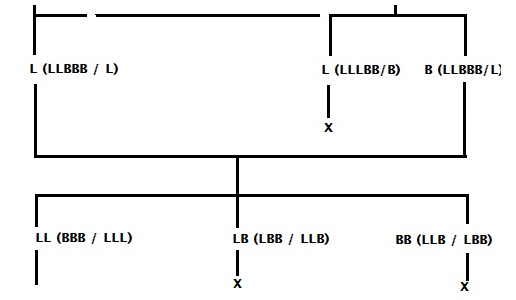
Let’s do a systematic decision tree that includes all (allowed) possibilities. What are the starting possibilities (trip 1)? They are one lion taking the raft (L), one wildebeest taking the raft (B), two lions (LL), two wildebeests (BB) or one lion and a wildebeest (LB). We will ignore L and B from the list because we know they must return (trip 2), thus nullifying trip 1. Therefore, the valid moves are:

An explanation for the shorthand: There are three options for trip 1 – LL, BB and LB. The notation in the parenthesis is the expected outcome in the end, e.g. if LL happens. And what remains on the start shore is LBB, and the endpoint (after the “/”) is LL. “X” means the move is unacceptable (three lions and one wildebeest on one side). The possible next actions (trip 2) are:

I guess the notations and the outcomes are clear by now. One of the trips (L) is not possible; it leads to 3 lions on one side. There are two possible remaining moves, and interestingly, both will lead to the same outcome (LLBBB/L). So, the next trip (trip 3) starts from a common origin (LLBBB/L).

Trip 4:

Trip 5:

The following six trips are:

Can you solve the river crossing riddle? – Lisa Winer: TED-Ed

Lions and Wildebeests Read More »

Lions and Lamb

Hungry lions and lamb is a classic game theory problem. It goes like this: there is a group of hungry lions on an island covered with plenty of grass and no other animals in sight. The lions are perfectly rational, which means survival is their priority, and each knows the others are rational too. The former suggests they prefer hunger over death, and the latter implies they don’t try to outsmart each other.

One day, a lamb appears from nowhere. The lamb is just big enough to become a meal for one lion. And the lion that eats the lamb becomes too full to defend itself against another hungry lion. Given these situations, what is the survival probability for the lamb?

Let’s arrange the lamb and the lions as follows. Consider the simplest case of one lamb and one lion.

Since there are no other lions around, there is no threat for the lion to eat the lamb. What happens if there are two lions?

The situation is different here: lion2 is ready to eat lion1 if the latter chooses to eat the lamb. So, lion 1, being rational, controls the impulse and spares the lamb. The lamb survives. What about three lions?

The lion3 is ready to eat lion2 if the latter becomes full. Knowing this reasoning, lion2 will spare lion1. Since the lion1 knows that, it will eat the lamb.

To conclude: if there are an odd number of lions in the pride, the first lion can eat the lamb without worrying about being eaten by other lions. If the number is even, the lamb will be spared.

Lions and Lamb Read More »

The G.O.A.T. Debate

Who is the GOAT in sports? Imagine you asked this question and got an answer; what is the expected response? Notice that we are only interested in those who responded; a fair proportion of humans may not care much about the question. Therefore, positive responses have an inherent survivorship bias in them!

There is a strong possibility that you get Lionel Messi as the answer. There is also a, albeit smaller, chance that you obtain LeBron James. To a certain degree, both are on top of their respective fields – LeBron in Basketball in the US, Messi in Football in the rest of the world! Partly also due to LeBron getting the all-time scoring record in the NBA earlier this month (February 2023) and Messi’s recent victory in the world cup (December 2022). The last statement reflects a combination of recency bias (both events happened recently and are fresh in the memory) and availability bias (can’t blame an American for not knowing Messi as much).

Taking a step further, if you get an answer and the person is in the 40-50 age bracket, there is a chance that the answer is Michael Jordan in the US or Diego Maradona for the rest. Here, it is unlikely the recency, but the availability bias. That connects to what the person could recall from the 1980s and 90s.

Sports historians, on the other hand, may have other candidates, the names the general public may choose to ignore. It could be Muhammad Ali due to his undeniable stature as a heavyweight boxer, social activist and pop culture icon. It could be Pele, Jesse Owens or Serena Williams, all of them had odds-defeating stories to reach their greatness.

A goat is just an animal

You may recognise the recency bias as a subset of the availability bias. The latter describes someone making a choice based on immediate examples that come to mind, which can very well be information acquired recently.

Finally, the GOAT debate is only relevant to those who follow sports with some passion. For the majority of humans on this planet, the phrase “the greatest of all time” may not even exist, or if it exists, it could well be Gandhi, Mandela, King or someone else that touched their lives.

References

The availability heuristic: Wiki
The recency bias: Wiki
Recency bias in trading: Youtube

The G.O.A.T. Debate Read More »

The Easterlin Paradox

The Easterlin Paradox, named after economist Richard Easterlin, addresses the relationship between happiness and income. First, the expected part: there is a positive relationship between the real income of people and their happiness – both among countries and within countries. In other words, the richer are happier.

But when it comes to changes in income or living standard as a function of time, happiness tends to remain flat. For example, the real (inflation-adjusted) per capita GDP of the United States was $25,083 in 1972, which became more than doubled ($56,000) by 2018. Yet, the Percentage of people who responded “very happy” was 30% in 1972 and 32% in 2918, and “pretty happy” moved from 53% to 57% in the General Social Survey. Also, the proportion of people who felt their financial situation changed for better or worse remained the same.

The contradiction in the relationship at a point in time vs as a function of time is the essence of this paradox. A possible explanation lies in the argument that the happiness of one arises from comparison with the other. So, even when the whole society moves up richer, if the individual sees no differential growth of their wealth compared to the neighbour, she could feel no increase in happiness. Another explanation is how fast people get used to wealth, and marginal values no longer give the same thrill – some form of diminishing marginal utility.

References

The General Social Survey: GSS
Real gross domestic product per capita: FRED
Easterlin paradox: Wiki

The Easterlin Paradox Read More »

Attacker-Defender Game

We have seen the rock-paper-scissors game in one of the previous posts. Let’s see an application of this in real life. Imagine there are several roads leading to the city in a trouble-hit area, and the police (or military) want to check for potential weapons carried by the criminals.

In such situations, the authorities have a limited scope to implement a deterministic strategy to block one road and check. The perpetrator will soon figure out the idea and prepare plans to avoid the threat. So, what works for the police is to confuse the attackers by choosing checkpoints randomly. In game theory language, this is called a mixed strategy, where the player has multiple options with positive probability. This is contrasted with pure strategy, in which the player has only one action with a positive probability.

Mixed Nash: Game Theory Online

Attacker-Defender Game Read More »

Illusory Correlation Bias

The illusory correlation refers to the error by the human mind that finds correlations between two events that are not correlated. These are sweeping generalisations by the brain that wants to conclude an event quickly (and efficiently). While we all are victims of this bias – fear of strangers, patterns of momentum in share prices, trust in lucky charms – it is not fun to know that psycho-diagnosticians, too, make these errors.

DAP and Rorschach

The pioneering works of Chapman and Chapman analysed popular psychodiagnostic tests such as Draw-a-Person (DAP) and Rorschach in the 60s. In one such study, the researchers presented drawings and descriptions of random symptom statements to a batch of practising clinicians and naive observers. You may know that psycho-diagnosticians have standard checklists correlating the behavioural characteristics of patients with their sketches. And it was no surprise that the observers fell for the stereotypes, just as the clinicians, correlations between random drawings of broad shoulders with manliness, large heads with intelligence etc.

Chapman, L. J.; Chapman, J. P., 1967, Genesis of popular but erroneous psychodiagnostic observations, J Abnorm Psychol, 72(3), 193

Chapman, L. J.; Chapman, J. P., 1969. Illusory correlation as an obstacle to the use of valid psychodiagnostic signs, J Abnorm Psychol, 74(3), 271

Illusory Correlation Bias Read More »

The Dollar Auction Game

An auctioneer auctions a dollar bill at a starting bid of 5 cents, with a ‘simple’ condition – i.e., is both the highest and the second highest bidders pay. What then happens? It is a game devised by Martin Shubik of Yale University.

Imagine the first person bids 10 cents, thinking of pocketing a profit of 90 cents. But she is among a group of strangers, and another person, seeing the opportunity for an 85 gain, bids 15. Now, the first person can do two things – give up 10 cents and quit or continue bidding (perhaps 20 cents).

If she persists and the story repeats, a few interesting things can happen: 1) the auctioneer gets more than $1 (when the person bids for 55 cents and the previous one was 50 cents), 2) the highest bidder loses money (when she bids $1.05; more than the value of the bill).

A few more things can happen. One of them is the case when nobody bids. This is the best outcome in which no one loses (and gains!). The second possibility is for the first person to start at 5 cents and then form a coalition with the rest so that no one else bids. This results in a loss of 95 cents to the auctioneer. A third possibility is to raise the bid to 95 cents by the first person. This makes any subsequent offers unattractive.

Martin Shubik, The Dollar Auction game: a paradox in noncooperative behaviour and escalation. Journal of Conflict Resolution, 1971, 15 (1), 109-111

The Dollar Auction Game Read More »