It comes from an article written by Carlo M. Cipolla in the 1970s. He puts forward five laws.
Everyone underestimates the number of stupid people around you. It means people often get carried away by what they see from outside – education, race, eloquence etc.
The probability of a person being stupid is independent of any other characteristic of that person. In other words, stupidity is uncorrelated with gender, nationality, wealth or education.
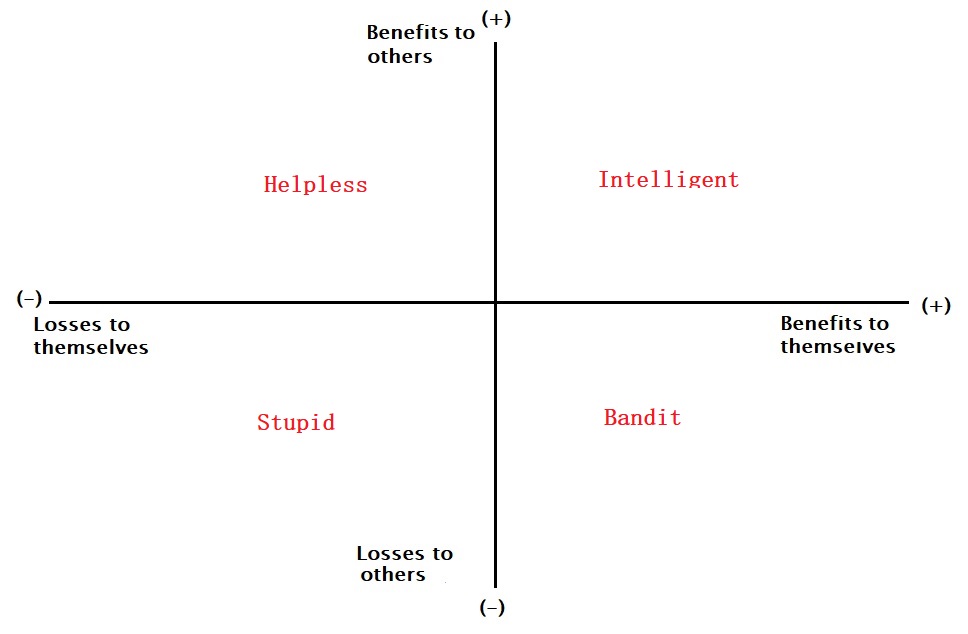
The stupid person causes losses to others while deriving no gain and possibly incurring losses.
Non-stupid people always underestimate the damaging power of stupid individuals.
A stupid person is the most dangerous type of person
Cipolla built a 2 x 2 matrix to explain rule number 3.
In 1973, Mark Granovetter reported in a paper titled “the strength of weak ties” that acquaintance and weak ties are more effective – be it creativity or getting jobs. As a definition: strong ties are between densely knit close friends, whereas weak links are between people with infrequent interaction and a lack of any emotional connection. He hypothesised that the diversity of information and ideas inside the “diffused” network (as against close-knit groups) of people was responsible for such observations.
While it remained a paradox and got support from many subsequent studies, the confounding of two parameters – the number and the strength of bonds – was not apparent in these studies. A 2017 work that looked at 17 million social ties from Facebook users concluded that the usefulness of weak ties arises because of the sheer number. In other words, while the probability of getting something (a new idea or a job) helpful from weak connections may remain low, the numbers are overwhelmingly larger than strong relationships; the former get the overall advantage.
Granovetter, M. S., American Journal of Sociology, 1973, 78, 1360 Gee, L.K. et al. / Journal of Economic Behavior & Organization, 2017, 133, 362
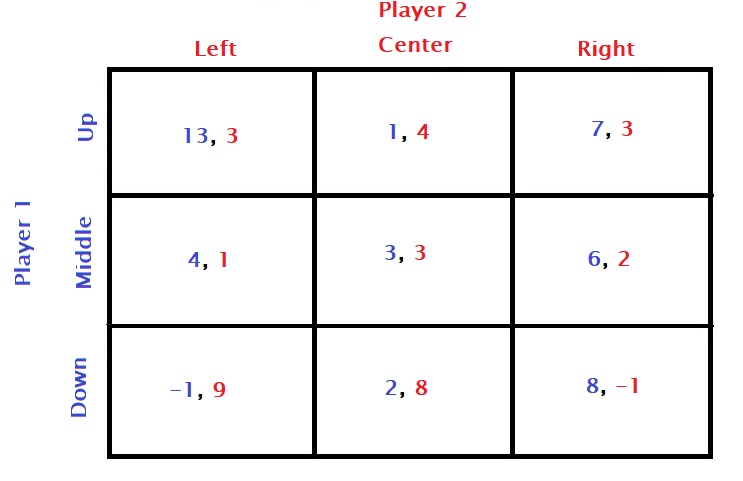
See a game played between two rational players with the following payoff matrix.
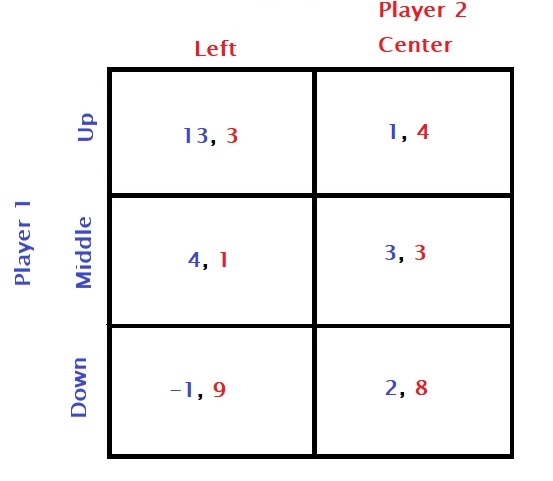
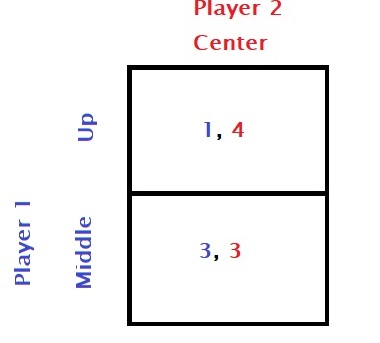
Looking at the matrix, one can see that player 2 is unlikely to choose the right strategy as her payoffs, 3, 2 and -1, are worse off against left and centre. So for player 2, the matrix is the following.
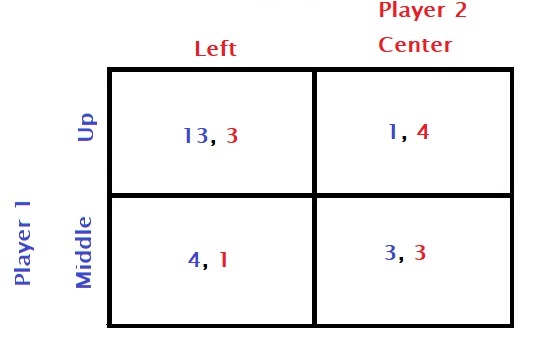
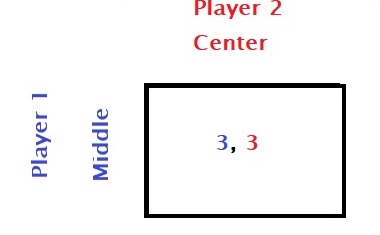
Player 1 knows what Player 2 is thinking because she is also rational. She looks at her options and concludes that down is no longer an option for her (- 1 < 4 and 2 < 3). So he eliminates the row corresponding to down.
Player 2 knows that the option down is the least favourite to Player 1, so she compares options left and centre. Centre dominates (4 > 3 and 3 > 1).
If that is the case, Player 1 will choose the middle, which gives her a better incentive.
The whole game structure is common knowledge between the two players. Such games are known as iterated elimination of strictly dominated strategies or IESDS.
Based on what we have seen so far, let’s put together three strategies for games we have encountered in the past. But before delving into those, look at Nash’s theorem, which suggests that there must be at least one Nash equilibrium in all finite games. Watch out for those two words: Nash equilibrium and finite games!
A finite game has a fixed number of players, a defined set of rules, and a known end. Nash equilibrium is the state of a game where the player has made her best decision or has no incentive to change the decision, assuming all other players maintain their current strategy.
The dominant strategy
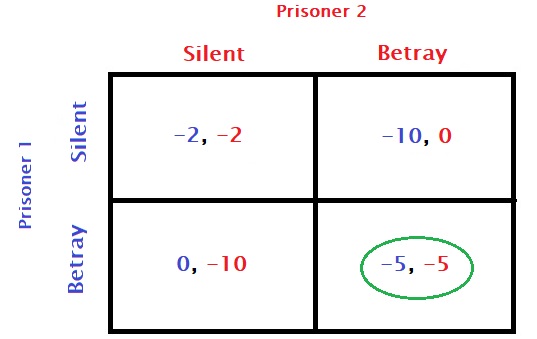
Remember the prisoner’s dilemma? The prisoner has a clear move irrespective of what the others will do. To put it in the language of the payoff matrix,
In the first instance, they may appear the same: one best outcome, one sub-optimal and two places with mixed incentives. But look carefully: in the first game, imagine you are prisoner 1, and think about your reward (the blue number) based on the two possibilities of the other player. If prisoner 2 is silent (first column), then your choice is to betray as 0 > -2 (compare the two blue numbers of the first column). If prisoner 2 chooses to betray (second column), your choice is still to betray as -5 > -10 (compare the two blue numbers of the second column). 100% clarity!
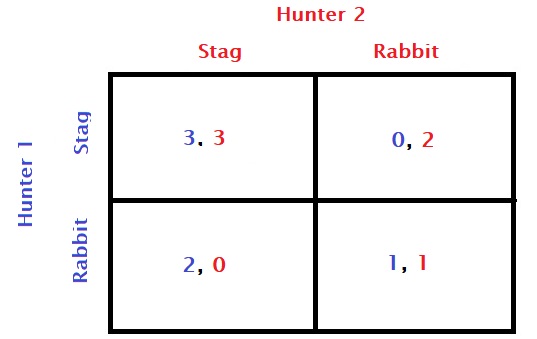
In the second case, repeat the above process. If hunter 2 brings the tool for the stag, the stag becomes your choice (blue 3 > blue 2). If hunter 1 gets the rabbit device, the rabbit is your choice (blue 1 > blue 0).
The mixed strategy
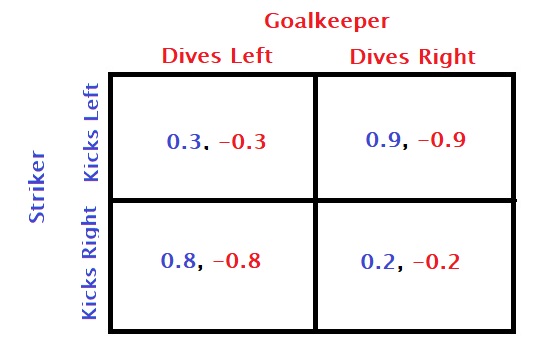
The penalty kick game is an example of a zero-sum game—one person’s win is the other’s loss. There is no pure strategy here; one needs to mix up (randomise) the plan to succeed. In other words, the strategy needs probabilistic estimation.
Two hunters want to go to a range which contains one stag and two rabbits. Each hunter will decide on the equipment to bring but won’t know what the other is carrying. Two people are necessary to hunt a stag, but one is sufficient to catch rabbits. And a stag catch is always a better deal as it has more meat. The payoff matrix is:
Hunter 2
Stag
Rabbit
Hunter 1
Stag
3,3
0,2
Rabbit
2,0
1,1
So, if both hunters bring devices for catching stag, they get the maximum benefit (3 each). If only one brings tools for rabbits, that person will get both rabbits. If both get tools for the rabbit, they split one each.
The game has two pure-strategy Nash equilibria – rabbit-rabbit and stag-stag. And the best situation is the latter. On the one hand, this differs from the prisoner’s dilemma because it has a dominant strategy (to betray), and the stag hunt has none. What is similar in both cases is the role of cooperation among players.
In a fully cooperating regime, both players expect the other to bring in tools for stang, and both reap maximum benefit. But if one player has even a slight doubt about the other (that the other will bring an instrument for the rabbit), she has no choice but to get the same tool or end up with nothing.
German philosopher Carl Gustav Hempel introduced this in the 1940s, questioning what composes evidence for a hypothesis. Here is how the paradox works:
You see a raven, and it is back. Then you see more ravens, and they all tend to be black. These observations prompt the scientist in you to form the hypothesis that all ravens are back.
So far, so good. Now it becomes a conditional (statement of the form: “if A, then B”). As per logic, a conditional is equivalent to its contrapositive:
If A, then B == If not B, then not A
For ravens, the equivalent statement is:
All ravens are black == All non-back things are non-raven, or if an object is not black, then it is not raven
Now let’s collect evidence for the hypothesis. Every black raven is a piece of evidence. Every non-black non-raven also has to be evidence! Green grass, red shirts, and yellow flowers are some examples.
So, what is the issue with this? Well, there could be rare non-black ravens which escape our sight. In the original form of the hypothesis (conditional), you only sample ravens and verify their colour. But in the contrapositive form, you can potentially collect an infinite number of objects (every non-black entity in the world) and appear to strengthen your hypothesis significantly.
Inequality aversion is a concept in behavioural economics. It means humans have a notion of fairness and will reject what they consider as inequalities. This psychology is responsible for individuals refraining from targeting higher rewards if they perceive another party getting better incentives. We have seen this in the centipede game.
Kahneman et al. report results from their study in which they carried out telephonic surveys on the residents of Toronto and Vancouver. Each participant got a maximum of five questions regarding fairness in a telephonic interview.
Question 1
“A hardware store has been selling snow shovels for $15. The morning after a large snowstorm, the store raises the price to $20. Please rate this action.” 80% of the respondents thought it was unfair.
Question 2
Question 2 has two parts. 2A: An employee is working in a photocopying shop at a wage of $9/hour. Upon seeing unemployment rising in that area and noticing other smaller shops paying $7/hour for their employees, the owner reduces the employee’s wages to $7/hour. 2B: An employee is working as in question 2A. After she leaves, the employer recruits a new person at a wage of $7/hour.
To question 2A, 83% of the respondents replied as unfair, and to 2B, only 27%.
House on rent
Similar ideas of fairness exist in residential tenancy. Different rules of rent-hikes are accepted for a new tenant (higher tolerated) vs a tenant renewing the lease (lower). At the same time, people thought it was ok if the landlord sold the house and the new owner charged higher rent from the existing tenant!
Reference
Daniel Kahneman, Jack L. Knetsch and Richard Thaler: Fairness as a Constraint on Profit Seeking: Entitlements in the Market, The American Economic Review, 1986, 76(4), 728
Here is a puzzle. There is a 200 EURO currency in one of the two envelopes, A and B. If you guess the right one, you can get the cash. Additionally, you can avail of a clue, which works as follows: There is a jar with five balls in it – three of them having the alphabet (A or B) of the envelope that carries the currency and two with the other alphabet. You can pick on the ball at random if you like. The price to pay for the clue is 25 EURO. The questions are:
1) Is the clue worth 25 EURO? 2) If not, what is the maximum amount you would like to pay? 3) Would you be willing to pay for a second clue and pick up another ball?
Let’s answer the first question. The expected value from the guess without taking any clues is 0.5 x 200 + 0.5 x 0 = 100 EURO. It is because there is a 50-50 chance that your guess turns right. What is the expected value of the guess with the first clue? It is 0.6 x 200 + 0.4 x 0 = 120 EURO. When you pick one ball, there is a 60% (0.6) chance that it is the right one (3 out of 5) and a 40% chance it is the wrong one.
Therefore, the maximum added value of going for the clue is 120 – 100 = 20 EURO. So, the answer to the first question is NO, and the second is 20 EURO.
What about a second pick? To answer this, we will need to perform several conditional probabilities using our favourite Bayes’ rule, which we’ll do next.
Is Extra Information Helpful? A Probability Puzzle: William Spaniel
Psychological experiments, despite their imperfections, still offer valuable insights into human behaviour. Well-known Imperfections are their lack of reproducibility and the nature of participants – typically originate from a narrow distribution of the society, e.g. students. The paper from Kathleen Vohs, Nicole Mead and Miranda Goode is an example we want to discuss today. They investigated how the notion of money (actual cash or a mere thought) can change one’s attitude while doing a job.
Self-sufficiency hypothesis
Before we get into the details, let’s understand what is meant by self-sufficiency. It is a concept where an individual recedes from the collective to herself and spends her effort towards achieving personal goals. The objective of the experiment was to verify the hypothesis that the concept of money can make a person self-sufficient.
Two tasks
The experiment consists of two tasks: 1) descramble 30 jumbled words, and 2) complete a challenging problem of arranging 12 disks into a square.
Three groups
The participants are arranged into three groups. Control group – gets neutral words to descramble and do the second task; the play-money group – gets neutral words in task 1 but primed with a pile of monopoly money while doing task 2; the money-prime group – gets money-related words to descramble and then do the second task. Before leaving the room, the investigator mentioned his availability to help if required. Therefore, the measurement parameter of the experiment was persistence (time before a participant seeks help).
The results
The results fulfilled the hypothesis – the money groups (money-prime and play-money) both parties took the job seriously and spent more time before approaching the investigator for help. The mean times were money prime = 314.06 s (sd = 172.79); play money = 305.22 s (sd = 162.47) and control = 186.12 s (sd =118.09).
Kathleen D. Vohs, Nicole L. Mead, Miranda R. Goode, The Psychological Consequences of Money, Science, 2006, 314.
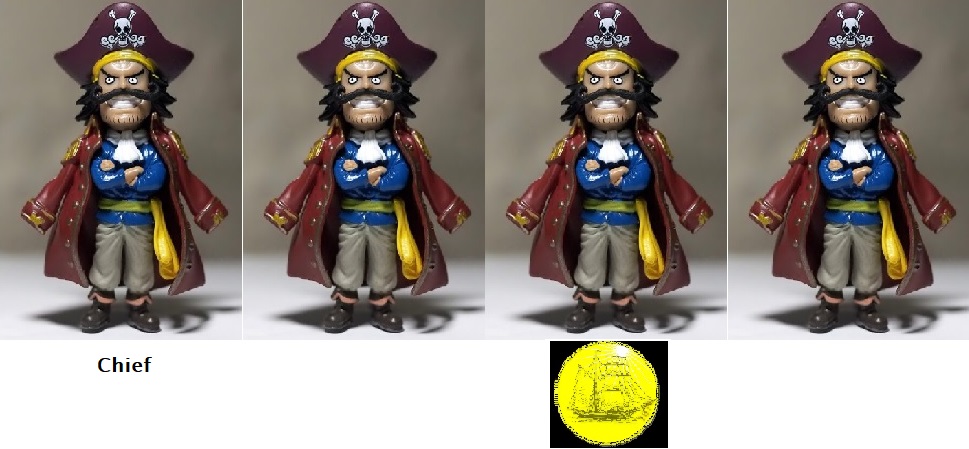
The pirate chief and his four mates found 100 gold coins and wanted to divide them among themselves. As expected, they are perfectly rational and strategic people. Here are a few rules.
The leader can propose a division.
If half of the team (including the leader) accepts the proposal, it becomes valid.
If not, the chief will be thrown out, the next in line will become the chief, and the game will continue.
So, what should be the chief’s offer to survive?
To find the solution to this problem, we must start from the last pirate and work backwards.
If the last one becomes the chief, he doesn’t need to make any offer and can keep all 100 coins. Simple! But what happens if two pirates remain? Then, the chief can decide not to give anything to the last one as he secures the approval by voting himself.
So, moving another level up – with three pirates. The chief requires at least two votes, but he gets one, i.e., his own. Also, he doesn’t want to give away more money than he needs to. Which of the other two pirates is cheap to buy? There is no point in giving money to the next person as he will disapprove; he knows he can keep all the coins by becoming the nest chief. Therefore, the last guy will vote for the current chief if the former gets at least one coin.
Now, four. The chief needs one more vote. He looks at the three and figures out what would happen if he loses, and the second one becomes the new chief. If that happens, the third one will not get any coin. Therefore, he becomes the cheapest vote to buy.
In the last case, the original case with five pirates, the chief needs three votes to survive. One comes from him, and he needs to buy two more. There is one cheap way: we know what happens if the proposal fails and the next becomes the chief. That will lead to the third and fifth not getting any coins, and they know that. So buy those two.