All

Population and Sample

We have used these terms many times in the past. This time, we look at their formal definitions.

Population describes the set of all possible observations. For example, the population relevant for the US presidential election represents all eligible voters in the states, which is about 240 million. If one wants to determine the true average height of adult women in the US, one needs to collect data on ca. 108 million females 18 years and older. Similarly, to obtain the real fault rate of a product, the factory manager needs to inspect all products it manufactures!

Collecting data from every single individual (product) is not practically possible. What is possible is to inspect a fraction of the population. This subset is called a sample.

The characteristic of a population is known as a parameter. E.g., the mean height of adult women in the US is a parameter with an exact value. You get it if someone cares to measure every individual of that population. The two most popular parameters are mean (mu) and standard deviation (sigma)

\text{population mean } = \mu; \text{ population standard deviation } = \sigma

A statistic is a characteristic of a sample. The sample mean and the sample standard deviation are the corresponding terms for samples.

\text{sample mean } = \bar{X}; \text{ sample standard deviation } = s

Inference statistics is a means to estimate (population) parameters from (sample) statistics. While it is possible to get a representative sample as a proxy for the population, they are never equal. The differences between sample statistics and population parameters are called sampling error.

Population and Sample Read More »
Should Butler Play Game 4?

Let’s attempt to understand the payoffs and coach Spoelstra’s options for game 4 of the NBA eastern conference final (ECF). Before we get into the arguments, here is a brief primer on the subject that we are discussing today.

The 2022 NBA ECF

And the matchup is between the Miami Heat and the Boston Celtics, with the Heat leading 2-1 at the end of game 3. Game 4, just like game 3, is at Celtic’s court, TD Gardens. So, there is a homecourt advantage for the Boston team. Heat’s star player Jimmy Butler just got injured (knee inflammation) in game 3. Let’s assume the injury was not a serious one, and there is a possibility he could be back for the next game. After game 4, there is a maximum of 3 more games, two of them in Miami’s backyard. Whichever team reaches four wins first will win the conference and advance to the NBA finals.

Butler brings advantage, and so is home.

Let’s write down the key assumptions and payoffs. If Butler plays, his team gets a boost of about 0.2 probability points over not playing. i.e., at home, it is 0.6 vs 0.4, and away 0.4 vs 0.2. If he plays in game 4, there is a 0.5 chance of aggravating his injury, making him unavailable for game 5. If he doesn’t play game 4, there is a 0.8 chance he plays for game 5 healthy, thanks to two additional days of rest. If the Heat wins game 4, it will be a huge boost to win the conference, as they have two home and one away matches to realise just one more win. If they lose game 4, it is still fine as they tie at 2-2, with two more to win with two home matches at hand.

What should Spoelstra do?

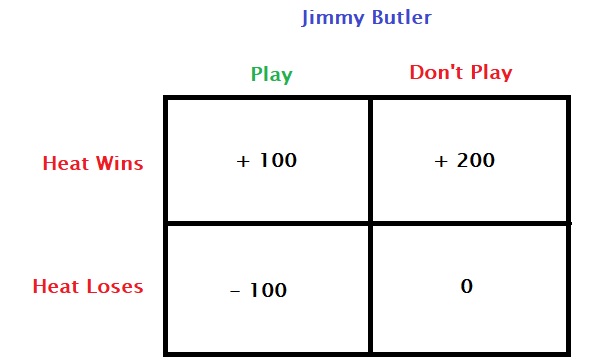
Well, he should weigh down factors and write payoff matrices and expected values. I will make one, not exactly a payoff matrix, but still capable of describing winning and losing with and without Butler.

These payoff values are arbitrary, but a win without Butler ranks the highest as he will be available as a fitter player for the rest of the games to close out. Butler playing and losing is risky as there is a higher chance of worsening the injury. And the other two results yield somewhere in between these two extremes.

Dominant strategy

If you compare the first column of the matrix with the second, i.e., comparing Butler playing with not playing, you will note that + 200 > + 100 and 0 > – 100. So, under these payoff values, Butler not playing is the dominant strategy.

Expected values

Let Vplay be the expected value for the Heat when Butler plays, and Vno-play when Butler does not play.

Vplay = 100 x 0.4 + (-100) x 0.6 = – 20

Vno-play= 200 x 0.2 + 0 x 0.8 = 40

Again, Butler not playing has the higher expected value.

Any doubts, coach?

The value of the above arguments is only worth the underlying assumptions, which, at this stage, are only arbitrary or speculative.

Tailpiece

(added on May 24, after the end of match 4). Butler played for the Heat, but the Celtics won by 20 points. Butler scored 6 points in the game (his previous scores were 41, 29 and 8). Whether his involvement in the match affected his fitness for future ties remains to be seen or will never be known.

Should Butler Play Game 4? Read More »

Self Biases

We shall see two interesting cognitive bises today – related to self! They are self-assessment bias and self-serving bias. From the psychological perspective, they both originate from our want to uphold self-worth and protect our ego.

Self-assessment bias, also known as the Dunning–Kruger effect, makes people overestimate their abilities. A famous example is a survey in the 80s at General Electric. The average engineer rated her performance inside the 78th percentile, and only two of the 92 surveyed thought they were below average!

On the other hand, self-serving bias is the tendency of the individual to claim credits if things go right (and blame others when wrong). While it may have originated from our desire to build and maintain high self-esteem, in the end, the results appear miserable and seriously impede our chances to learn from mistakes and succeed in life.

Self Biases Read More »

Linda’s Troubles

We have discussed the conjunction fallacy in Linda’s problem. While there are no two opinions on the notion that it is a fallacy, let’s explore why this is so normal to people. Before that, what is Linda’s problem? It is a common fallacy when people fall into the trap of selecting rare events which fit their existing stereotypes among options that include more probability. For example, people are happy to conclude that Linda is a banker and feminist versus just a banker once they hear the description that she is single, a fighter for social justice, etc.

More information supports arguments. Mathematically, AND between two statements signifies a joint occurrence, which is smaller (or equal at the maximum) than the smallest of probabilities. But it is perfectly normal for real humans to add more details and facts if we want to prove something. So, when they see multiple statements separated by an AND, they get a feeling for the validity of the statement. And if one of the statements fits their pre-existing notion, it becomes even more convincing.

Linda’s Troubles Read More »

Losses and Real Player

The issue with Thaler’s results is in the experiments themselves. Hypothetical questions answered by students are about to produce perfect answers! Real decision-makers, however, may behave differently.

First, there is no real money involved in those games. True decision-makers, accountable for gains and losses of real money, are only a minority of the population who might respond to such experimental questions. Therefore the sample may not even represent the right crowd.

Losses and Real Player Read More »

Losses and Rational thinker

In an earlier post, we have seen Thaler’s observations on how prior outcomes (wins or losses) impact the behaviour of a decision-maker. Thaler designed experiments to understand such behaviours using Kahneman and Tversky’s prospect theory. His hypotheses are called editing rules, which suggest that people edit outcomes in the way that makes them happiest.

Further to the experimental results that we have seen before, Thaler went on to do more that led to modifications of the editing rules to quasi-hedonic editing rules. Let’s see what he found.

Segregate gains, integrate losses

Results of the first experiment made the impression that people like to spread gains (happiness). The opposite, integration of the losses, although hypothesised, was not observed always. For example, in the second question of the previous post, Mr A, who lost $100 and $50 in two separate instances, is more up-happy than Mr B, who lost $150 once.

Response of a rational thinker to losses

Following is an interesting, albeit perfect, set of answers from university students.

1) Lose $9 vs Lose $9 after having lost $30. Loss of $9 hurts more in: Most of the subjects chose the second option.
2) Lose $9 vs Lose $9 after having lost $250. Loss of $9 hurts more in: There was almost 50:50 for either.

You may be wondering if this is how things happen to real people. It could be true for people who are answering the question without having to lose anything! It could also be true for people who lose money from factors which were not entirely their fault. But what about players, such as gamblers? Well, that is for another time.

Richard Thaler and Eric Johnson, “Gambling with the House Money and Trying to Break Even: The Effects of Prior Outcomes on Risky Choice”, Management Science, 1990.

Losses and Rational thinker Read More »

Skewness and Kurtosis

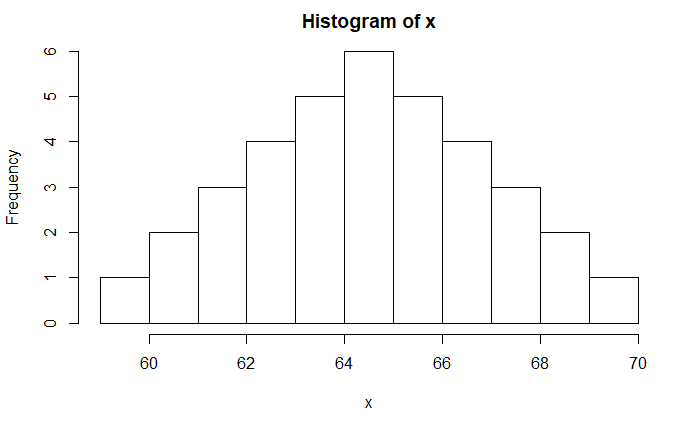
Skewness is the measure of symmetry or the lack of it. A symmetric dataset means data is distributed equally on the left and right of the mean (or median). Following is an example of a symmetric distribution.

Skewness

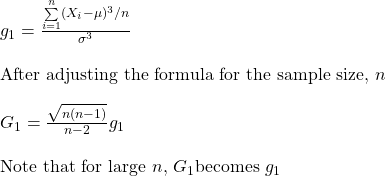
It is defined as (Pearson’s moment coefficient of skewness)

g_1 =  \frac{\sum\limits_{i = 1}^n(X_i - \mu)^3 / n}{\sigma^3} \\ \\ \text{After adjusting the formula for the sample size, }n \\ \\ G_1 = \frac{\sqrt{n(n-1)}}{n-2} g_1 \\ \\ \text{Note that for large } n \text{, } G_1 \text{becomes } g_1

The skewness of the data is close to zero for symmetric distribution, which is the case with the figure above. A positive value for g1 indicates positive skewness or right-tailed, and a negative g1 is for negative skewness or left-tailed.

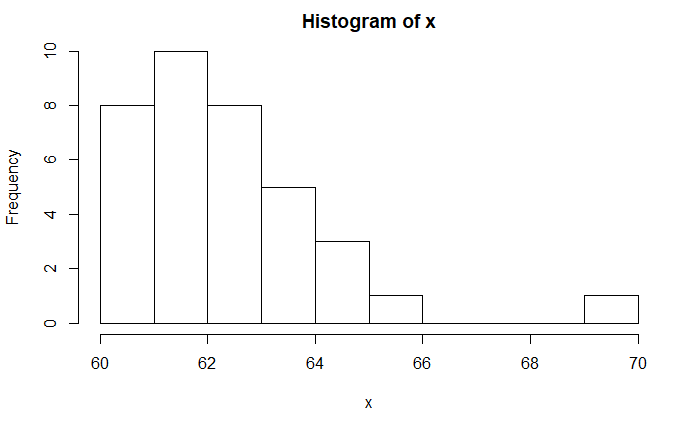
Following is an example of a positively skewed distribution (right-tailed). Its skewness is calculated to be 1.08 using the R function, ‘skewness’ (you must install library ‘moments‘ for that).

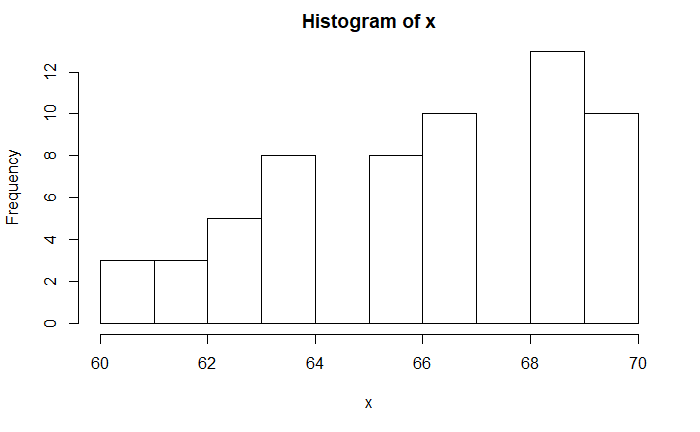
In the same way, the skewness of the following plot is -0.43; it is a negatively skewed distribution (left-tailed).

Kurtosis

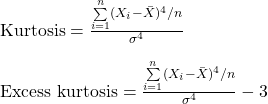
Kurtosis is the measure of how heavy or light the tail is.

\\ \text{Kurtosis}  =  \frac{\sum\limits_{i = 1}^n(X_i - \bar{X})^4 / n}{\sigma^4} \\ \\ \text{Excess kurtosis}  =  \frac{\sum\limits_{i = 1}^n(X_i - \bar{X})^4 / n}{\sigma^4} - 3\\ \\

A kurtosis value of 3 indicates standard normal distribution. Excess Kurtosis (Kurtosis – 3) is a deviation from a standard normal distribution.

Finally, the codes used to generate those distributions and their properties.

library(moments)


x <- c(rep(59.99999, each = 1), rep(61, each = 2), rep(62, each = 3), rep(63, each = 4), rep(64, each = 5), rep(65, each = 6), rep(66, each = 5), rep(67, each = 4), rep(68, each = 3), rep(69, each = 2), rep(70, each = 1))
hist(x, breaks = 10)

skewness(x)
kurtosis(x)

x <- c(rep(60, each = 8), rep(62, each = 10), rep(63, each = 8), rep(64, each = 5), rep(65, each = 3), rep(66, each = 1), rep(70, each = 1))
hist(x, breaks = 10)

skewness(x)
kurtosis(x)

x <- c(rep(60, each = 1), rep(61, each = 2), rep(62, each = 3), rep(63, each = 5), rep(64, each = 8),
rep(66, each = 8), rep(67, each = 10), rep(69, each = 13), rep(70, 10))

hist(x, breaks = 10)
skewness(x)
kurtosis(x)

Skewness and Kurtosis Read More »

What Monty Must Do

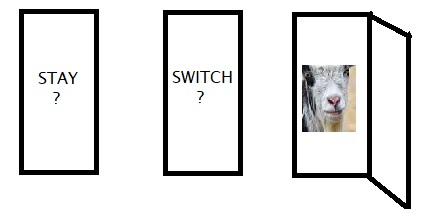
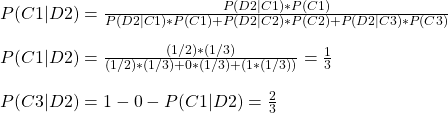
This one is about what Mr Monty shouldn’t do in the game show! The discussion on the “ideal” Monty Hall problem is available in a different post. Nonetheless, a quick proof is here. Suppose the player chose door 1 and Monty opened door 2, the probability of the car behind door 1 given Monty opened door 2 is P(C1|D2). Applying the Bayes’ formula,

\\ P(C1|D2) = \frac{P(D2|C1)*P(C1)}{P(D2|C1)*P(C1) + P(D2|C2)*P(C2) + P(D2|C3)*P(C3)} \\ \\ P(C1|D2) = \frac{(1/2)*(1/3)}{(1/2)*(1/3) + 0*(1/3) + (1*(1/3))} = \frac{1}{3} \\ \\ P(C3|D2) = 1 - 0  -  P(C1|D2)  = \frac{2}{3}

Explanation

The prior probabilities, P(C1), P(C3) and P(C3), are all equal at 1/3. P(D2|C1) = 1/2 because Monty can not open D1, and only D2 or D3 (one out of two) is available. P(D2|C2) = 0 since Monty can never open D2 if the car is behind the door 2. Since the car really exists behind one of those doors, P(C1) + P(C3) + P(C3) and P(C1|D2) + P(C2|D2) + P(C3|D2) are both unity.

The real-life Monty vs the perfect problem

The motivation for this post is when I read somewhere that Monty Hall did not always open the door in the game show. If that was true, then the TV show presented a different uncertainty than what should’ve been a calculated risk due to probability.

What Monty Must Do Read More »

Basics Continued

Continuing from the previous post, we will calculate a few more properties. We start with percentiles.

2152944506173
3163244516274
9193244526975
12203745546979
12223848546988
15263849567290
15283850577293

Percentiles

Percentile, Px, is the value below which x percentage of the data lies. It is calculated as:

P_x \approx \frac{x(n+1)}{100}

For the problem described above, P10 = 10 x 50 / 100 = 5, for n = 49. I have marked the fifth element of the table in bold (12). Similarly, P90 = 90 x 50 / 100 = 45. The 45th element is 75.

quantile(machine, 0.1)
quantile(machine, 0.9)

Quartiles

Extending it further, we can get the quartiles as P25 (first quartile, Q1), P50 (second quartile, or median, Q2), and P75 (third quartile, Q3). P25 comes out to be (25 x 50 /100), the 12.5th element. You either round it off to the nearest whole number (13) and select the 13th number, which is 26 or take the 12th number and add 0.5x(13th – 12th) = 22 + 0.5 x (26 – 22) = 24. Or 25% of the instruments will fail by 24 weeks. Similarly, P75 = 37.5th element = 69.

Inter-Quartile distance (IQD) is the difference between Q1 and Q3. Here, 69 – 26 = 43.

Variance

Variance is the measure of the variability of the data from the mean

\text{population variance } = \frac{\sum\limits_{i = 1}^n(X_i - \mu)^2}{n}

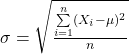
The square root of the variance is the well-known standard deviation.

\sigma = \sqrt{\frac{\sum\limits_{i = 1}^n(X_i - \mu)^2}{n}}

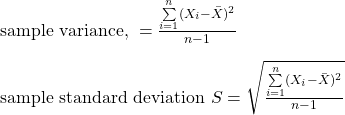
Note that the above equations are for the population. The corresponding entities for the sample are

\\  \text{sample variance, }  = \frac{\sum\limits_{i = 1}^n(X_i - \bar{X})^2}{n -1} \\ \\ \text{sample standard deviation }S = \sqrt{\frac{\sum\limits_{i = 1}^n(X_i - \bar{X})^2}{n -1}}

Chebyshev’s theorem

It is an empirical rule to predict the proportion of observations likely to lie between an interval defined using mean and standard deviation.

P(\mu - k\sigma \le X \le \mu + k\sigma) \ge 1 - \frac{1}{k^2}

For example, what proportion of data lies between two standard deviations? It is 1 – 1/22 = 0.75 or 75%. In our case, the mean is 44.94, and the standard deviation is 24.19. The interval is between [44.94 – 2 x 24.19] and [44.94 + 2x 24.19] or between -3.44 and 93.32. The number of data between these is everything or 100%! So Chebyshev gives an approximation lower than the exact. You may recall that for normally distributed data, two standard deviations cover about 95% of the data.

Basics Continued Read More »

Back to basics

We have seen and used them before. But let’s refresh a few basic statistical parameters once again. The mean time between failures (MTBF) of an instrument (in weeks) is as per the following table. Calculate the key parameters to summarise the performance.

2232442905620
3932932281238
75693761543879
15451215624950
88744438695751
15691648447252
7226919735450

There are 49 data points in total. We will estimate the mean, median, mode, and time for 10% (P10) and 90% (P90) to fail.

Central Tendency

Mean, median and mode give the central tendency of the data. The mean is the average of the data. Sum all the numbers and divide by the total number (49).

\text{Mean } = \bar{X} = \frac{\sum\limits_{i=1}^{n}X_i}{n} = \frac{2202}{49} = 44.94

#The R code is
machine <- c(22, 32, 44, 2, 90, 56, 20, 3, 93, 29, 32, 28, 12, 38, 75, 69, 37, 61, 54, 38, 79, 15, 45, 12, 15, 62, 49, 50, 88, 74, 44, 38, 69, 57, 51, 15, 69, 16, 48, 44, 72, 52, 72, 26, 9, 19, 73, 54, 50)
mean(machine)

The median represents the mid-value of the data, i.e. 50% of the observations are below the median, and 50% are above. Let us rewrite the table in ascending order. The median is the value at the position (n+1)/2 if n is odd, and if n is even, it is the average between (n/2)th and (n+2)/2th. Since the number of observations is 49 (odd), the median is the 25th element, 45, which is highlighted in bold.

2152944506173
3163244516274
9193244526975
12203745546979
12223848546988
15263849567290
15283850577293
median(machine)

Mode is the most frequently occurring value(s) in the set. In our case, 15, 38, 44 and 69 occur the maximum (3 times). Since there is no in-built function for mode in R, we create one.

stat_mode <- function(x) {
  ux <- unique(x)
  tab <- tabulate(match(x, ux))
  ux[tab == max(tab)]
}
stat_mode(machine)

Back to basics Read More »