Decisions of groups

Decision-making in groups often suffers from what is known as the Arrow’s impossibility problem. Named after the American Economist Kenneth Arrow, this theory says that if a decision is made by a group of individuals who are not run by a dictator, through sincere voting, they may reach a state of non-transitive preference even if they are all rational.

The statement sounds very complicated. Let’s look at each of those words. First, something about the group – they are free and have clear preferences. The second one is non-transitive preference. To understand this, we must understand what transitive preferences are.

Transitive preference

Rational decision-makers have transitive preferences. That means if a decision-maker prefers A over B, then B over C, it must be that she prefers A over C. A sort of mathematical consistency. But this is so if the decision-maker is one person. What can happen if there is more than one? Take this example of three members of a local committee, Mrs Anna, Mr Brown and Miss Carol. The following represent their choices on what they prefer to build for the local community this year.

AnnaBrownCarol
First PreferenceSchoolLibraryPlayground
Second PreferenceLibraryPlaygroundSchool
Third PreferencePlaygroundSchoolLibrary

The committee votes for pair-wise comparison. The first is school vs library. Anna and Brown vote for their first choices, the school and the library, respectively, and Carol for school (because the library is her least preferred ). The school won 2-1.

The school vs playground happens next. The votes go through a similar process, and the playground wins this time, thanks to Mr Brown; the school was his least preferred option.

You may conclude that the committee should build a playground because it beat the school that defeated the library. But before that, they have to do the final voting- the library vs the playground. Since it was sincere voting, as you expected, the library won by 2 to 1 as Anna, the decider, broke the tie. And we ended up in a non-transitive situation.

Decisions of groups Read More »

Bayesian vs Frequentist

There are two main perspectives in statistical inference. They are Baysianism and frequentism. So what are they? Let’s understand them using a coin-tossing example. It goes like this. What is the probability of getting a head if I toss a coin?

Bayesian first assumes, then update

Well, the answer depends on whom you ask! If you ask a Baysian, she will start the following way: a coin has two sides – a head and a tail. Since I don’t know whether the coin is fair or biased, I assume in favour of the former. In that case, the probability is (1/2), and then, depending on what happens, I may update my belief!

Frequentist first counts, then believe

You ask the same question to the frequentist, and she will hesitate to assume but will ask you to do the tossing a hundred times, count them and then estimate!

How can one event has two different chances?

The toss just happened, but the outcome is hidden from your sight. The question is repeated: what is the probability that it is a head? The Bayesian would still say it is (1/2). The frequentist’s perspective is different. The coin is already landed, and there is no more probability: it has to be either a head or a tail. If it is a head, the answer is 100%, but if it is a tail, the answer is 0%!

Who is right?

If you recall my old posts, I have used Bayesian mostly in calculations but frequentist for explaining things. One classic example is the weather forecast. The easiest way we can understand a 40% probable rain tomorrow is if I tell you that when such weather conditions happened in the past 100 occasions, it rained in 40 of them. And you are happy with the explanation. But in my weather model, I may have used 0.4 as a parameter and depending on what happened tomorrow (actually, it rained), I may have updated my model like a true Bayesian.

Bayesian vs Frequentist Read More »

Confirmation Pull

Most of us acknowledge the need to be objective; in what we believe or what we decide. Yet, we find it tough to follow the path of true objectivity as the pull from the value system is so strong. And we settle for results that fit with our current ideas.

My-side objectivity

And that is confirmation bias. It is a state in which individuals will search, accept and interpret information that favours their existing beliefs. Traditionally it required active selection from the individual, be in the newspaper she chooses, the books she reads etc.

Filter bubble

Naturally, the bias also requires us to ignore the evidence that does not fit our liking. And that used to be a difficult job. But that is past. With the introduction of filter bubbles or those algorithms that choose the feed for you, confirmation has reached a different level. The algorithm practically takes the decision, on your behalf, on what to click on and what not to.

Confirmation Pull Read More »

Recency Bias

Recency bias is another common type of cognitive bias in which people’s decisions are influenced by what happened in recent times. An example is the bull and bear runs of the stock market. When the market is having a good time, people assume that it will continue and increase their investments, attracting even more into the bubble. On the other hand, when the market crashes, the trend reverses as more people want to sell, expecting the doom to continue. A lot of analysts, unaware of the bias, carry this fallacy and use the term momentum, a term borrowed from physics, to describe this phenomenon.

Another example is the mass cancellations after aircraft crashes. A recent news report says the cancellation, of close to 9000 flights, following the incident of a China Eastern Airlines flight in March this year. Interestingly this was the first fatal airliner incident in China in the last 12 years!

Recency Bias Read More »

Availability Bias

Availability bias is a mental shortcut for decision making that uses what comes to mind based on your impression, i.e. examples that are easily available to you to visualise. The following puzzle from Tversky and Kahneman is a nice one to illustrate this.

Look at the above two pictures and draw structures starting from the top row to the bottom by passing through one and only one X in a row. If you are not entirely sure about the task, let me illustrate it with examples. The following picture gives one such construction on each.

What comes to mind

If your answer is figure 1, then you are not alone. 46 out of 56 participants thought figure 1 has more paths than figure 2. Their median estimate was 40 in Fig 1 and 18 in Fig 2.

A permutation problem

It is a permutation problem that doesn’t need any guessing. Fig 1 calls for 8 ways to draw connections, 3 at a time or a total of 8 x 8 x 8 = 83 = 512 possibilities. The second one? Well, 2 ways, 9 at a time, 29 = 512 (2 x 2 x 2 x 2 x 2 x 2 x 2 x 2 x 2)!

Availability Bias Read More »

Microcredit and Grameen Bank

Convincing the bank if you don’t have money or collateral is difficult, if not impossible. It is now easier for the bank to reach its subgame-perfect Nash equilibrium by rejecting the application. Here the bank has done nothing wrong as its primary goal was to protect its business. But in the process, it made the poor out of the credit market, eventually throwing them into a downward spiral. On the other hand, the bank was far more confident with the rich because of the collateral.

Bangladeshi economist Muhammad Yunis, who later got the Nobel Peace Prize for this work, broke this spiral by founding a community development bank, Grameen Bank, employing the microcredit system.

16 Decisions

The banking system works by giving several small loans to a pool of interconnected people. Then, instead of creating any legal framework, the Grameen bank laid a value system by sixteen decisions. Those are aimed to foster discipline, community building, saving, and sustainability.

Introducing Game Theory: Ivan Pastine, Tuvana Pastine
Grameen Bank: Wiki

Microcredit and Grameen Bank Read More »

Sequential move games and Bank Loans

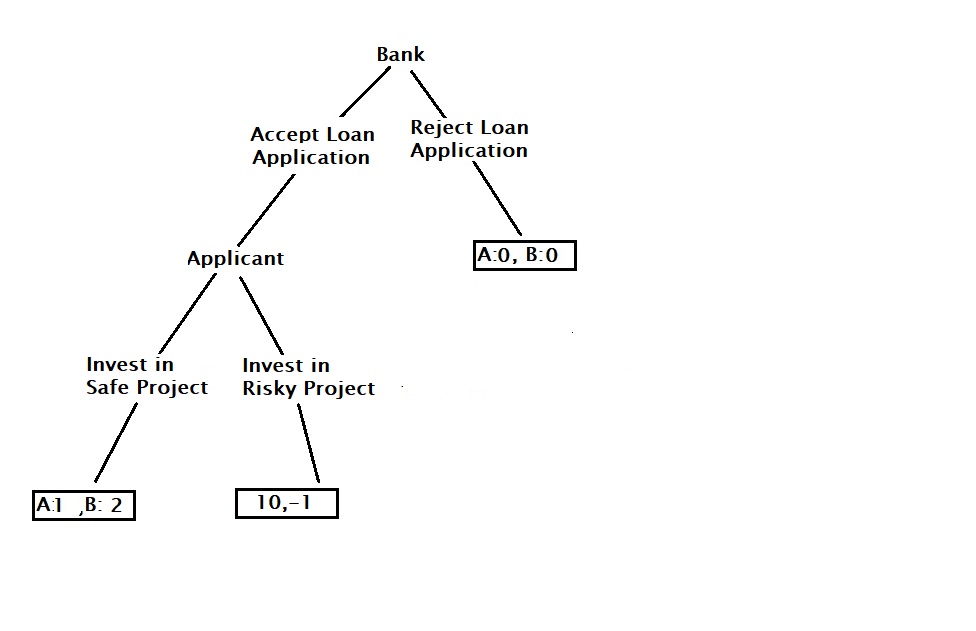
The interaction between a lender and a borrower is an example of a sequential-move game. The game tree, along with the payoffs, is shown below. A represents the applicant, and B represents the bank.

It is a sequential move game because the applicant gets the chance to invest in the project of her choice only after the bank has released the money.

Based on the payoff, it is easy to find that the bank gets a good deal only when the applicant invests in a safe project. If the bank doubts the applicant’s intention, it will reject the application straight away. In such a case, the applicant has only two choices: 1) convince the bank that she would invest in a safe project, 2) give collateral to guarantee the bank.

Sequential move games and Bank Loans Read More »

What happened to the Past Climate Predictions?

We have seen the role of climate models to understand the magnitude of global warming. Almost all of the narratives of catastrophe from the climate commentators go back to the output of climate models. And projections from these models play a crucial role in shaping our collective consciousness and aligning global policymaking to fight against this human-made problem.

Models also contribute to why the subject of global warming gets criticism from the sceptics. To most non-physicists, mathematical models represent fantasy, unconnected to reality. Also, projections are forward-looking, and it is easy to cast doubts in public minds for its alleged function as a crystal ball. Calling such people anti-science is easy but not entirely justified; after all, science too calls for the same; get the evidence and validate your predictions. So how do we validate a model prediction for the future?

Look for the past predictions!

Hausfather and others published a paper in the geophysical research letters in 2019 that exactly went for this. The work looked at various models published between the 1970s to the late 2000s. And what did they find? The team have gathered about 15 model predictions from the past and compared them with the observed data. They found that the predictions were well within the margin of errors of the observations. The models of the 70s, 80s and 90s were pretty accurate to predict the future, which is past by now!

What is a climate model?

A model gives a connection between an input and an output. It’s achieved using the physics of the process and represented through the language of mathematics. In the context of climate change, concentrations of CO2 in the atmosphere is the input, and the temperature rise (or fall) is the output. A typical model estimates the reason for the temperature change, i.e., the radiative forcing or the change in energy flux (the incoming – outgoing energy) on the planet. In other words, if the outgoing is less than the incoming, the temperature rises; otherwise, it falls, simple!

Why is this no news?

There are many reasons why a good match between a model and observations never makes it to the news. But, before getting there: why do you expect the predictions made by the collaborative works of 100s of top scientists to go wrong in the first place? We will explore the answer in another post. Now, let’s come back to why they didn’t become headlines. First, predictions happen today (which attracts news), but the data arrive 5-10 years later. By then, you may have forgotten about the original work! Secondly, matching an expectation does not make it sensational for the news. Imagine this news: “NASA scientists verified the physics of radiative forcing, again”! Third, a good match like this is more of a nuisance to the people who want to believe that climate change isn’t real (or who worry about the need to change the current lifestyle).

One such example is the projections made by NASA’s Hansen et al. in 1988. That story, in another post.

References

What happened to the Past Climate Predictions? Read More »

Battle of Sexes Continued

We have seen how coordination failure has led the game to a simultaneous move. Now, think about another scenario where there was no network failure, and the communication was possible between A and B. This can lead to another type of game; the sequential move. But before we move on to that, let us look at the original payoff matrix.

B
FootballDance
AFootballA:10, B:5A:0, B:0
DanceA:0, B:0A:5, B:10

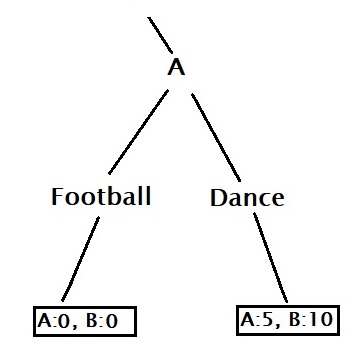
In this case, B finishes her job earlier, reaches the dance venue and calls up A. So B becomes the first mover, and A’s strategy now depends on the following game tree (full version).

Now that B has made her move, i.e. dance, the subgame has only the A’s part of the tree.

And the loving A has only one option to select and maximise the couple’s happiness! It has become a subgame perfect Nash equilibrium, favouring the early mover, B in this case.

Not a guaranteed success

Although the present story tells otherwise, there are no rules to guarantee maximum payoff for the first mover. There are several examples where followers benefitted from early movers’ mistakes, especially in businesses that require heavy R&D and are high in fast-evolving technology content. As per this HBR article, gradually evolving technologies and market gives the early mover better chances.

Battle of Sexes Continued Read More »

Battle of Sexes

Battle of sexes is an example of a game with multiple Nash equilibria. So what is it?

A and B are a couple who want to spend the evening together. A likes to watch football, but B prefers dancing. They go to work agreeing to call each other in the evening to meet up. Because of some network issues, they can’t communicate in the evening. So what is the strategy for the couple? Note that it has become a simultaneous move game. Let’s check the payoffs from each other’s point of view.

B
FootballDance
AFootballA:10, B:5A:0, B:0
DanceA:0, B:0A:5, B:10

A knows B has a chance to go to her favourite dance. Therefore, A decides to go to the dance. Since A has no liking for the show, he can’t get the highest payoff, 10, but is still happy to be with B. B, on the other hand, enjoys dancing with her partner.

From B’s angle, A could go for the football he loves. If both end up on the grounds, the payoff will be similar to the previous case, but the roles will be reversed.

Suddenly, the game has two Nash equilibria; a football equilibrium and a dancing equilibrium. So what could really happen? One possibility is a complete lack of coordination, and the Gift of the Magi, the perfect tale of love and sacrifice, re-enacts zero payoff but maximum drama!

Reaching equilibrium

An equilibrium can happen under any of the three circumstances
1) Equal-partner case: they end up at the same place by luck
2) A-dominating case: B has no doubt that A would be at the football place
3) B -dominating case: A knows B is determined to be at her favourite dance floor

Battle of Sexes Read More »