Natural Medicines and Fallacies

The terms nature and natural products invoke cult-like sentiments in society. They are usually used as opposites for synthetic products, chemicals, toxins, poisons, etc. Let’s look at some common irrationalities associated with ‘nature’.

Argumentum ad populum

Or appeal to the people. In simple language, it means since everybody thinks it’s true, it must be true! There are more reasons why something popular is likely wrong, especially in specialised fields of study, as the population of practitioners in topics such as medicine is negligible in society.

Post hoc ergo propter hoc

We have seen it before. It means Y happened after X; therefore, X caused Y. Almost all traditional medicines against what is now known as viral infections are examples of this fallacy. A famous example is Phyllanthus, as a cure for Hepatitis A, a water-borne viral infection (of the liver). The illness, if it’s caused by Hepatitis A or E, will go away in itself. But what happens if a person gets the same symptoms caused by Hepatitis B? Not something pleasant.

Argumentum ad antiquitatem

Appeal to tradition is often related to one’s cultural identity. It was written, so it must be true. A classical case is where people from the East think of modern medicines as Western medicines and take pride in ancient science that treated almost everything.

Absence of data as proof of absence

The presence of side effects is a common criticism directed against evidence-based, modern medicine. They consider the treatment of an ailment using a drug to be a trade-off between the risks and benefits. Naturally, this mandates the inventors to probe deep into the dangers and advantages of the given molecules used for treatment. Historically, similar scrutiny has never occurred in traditional medicines, thereby lacking data on their adverse effects.

Natural Medicines and Fallacies Read More »
Parrando’s Paradox

Let’s play this game: game A) You lose a dollar every time you play one game; game B) you lose five dollars if the money at hand is odd and gain three dollars if it’s even. You have 100 bucks at the start of each game; play for 100 games.

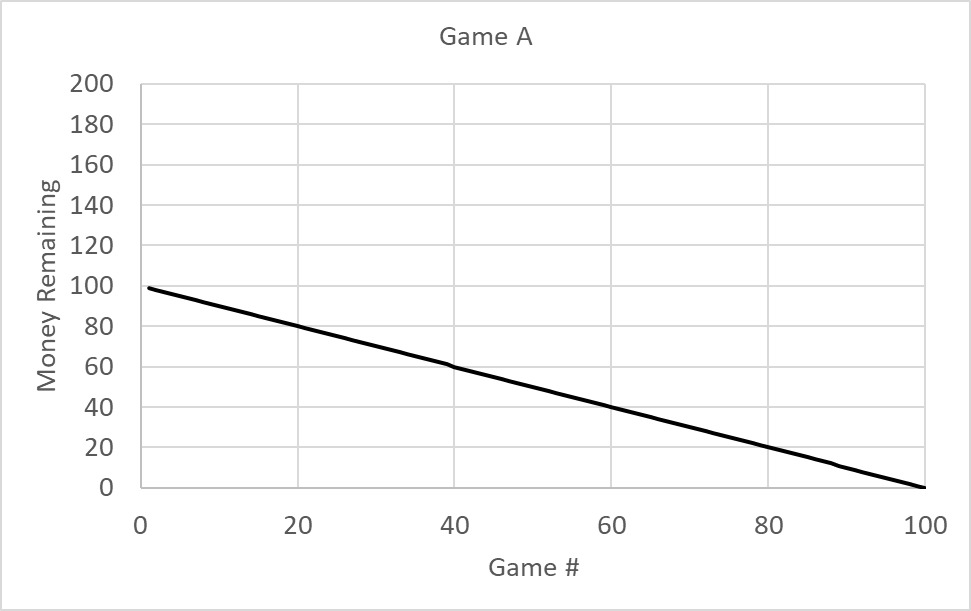
Following are the first few results from game A, followed by the plot of the results.

#Money
at hand
start100
199
298
397
1000

So, you are losing everything in 100 plays. Now, the second game: The excel code is: if(isodd(B1), B1-5, B1+3); assuming the starting 100 is in the cell, B1.

#Money
at hand
start100
1103
298
3101
496
1000

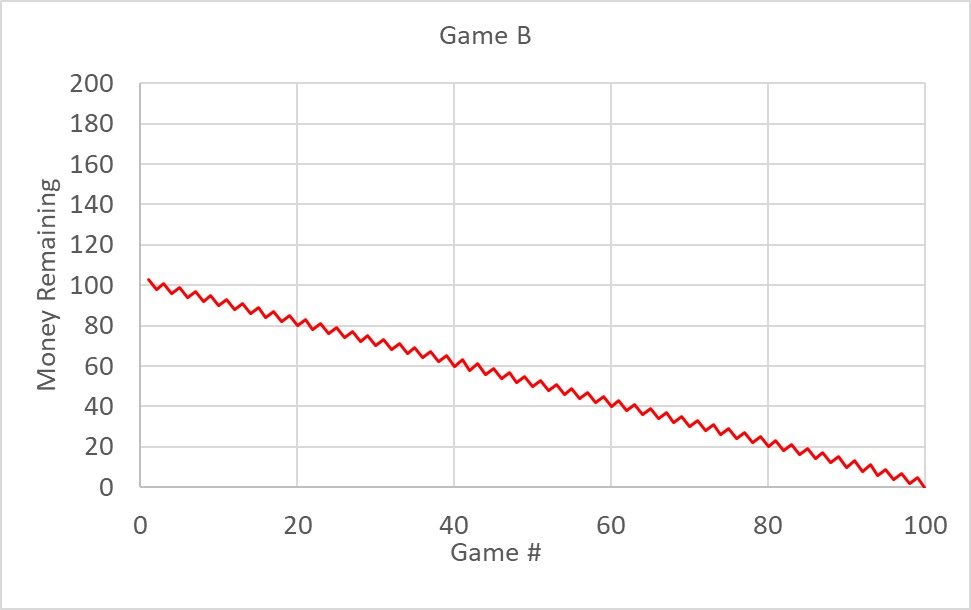
Again, you lose everything in 100.

Play two losing games!

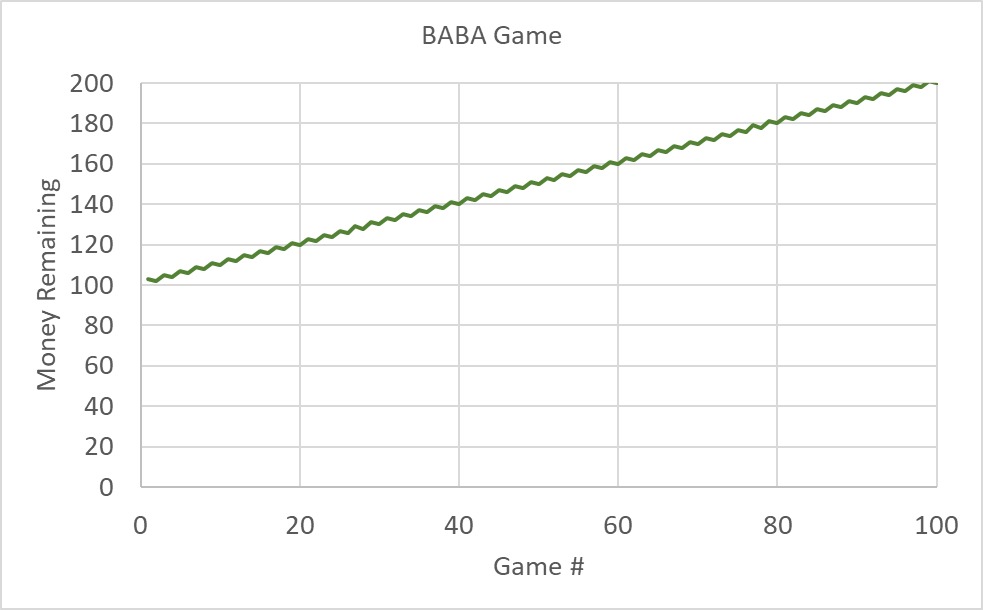
We have played two losing games. Now play game B and game A alternatively and see what happens. if(isodd(A2), if(isodd(B1), B1-5, B1+3), B1-1). The game number is in the A column, starting from A2, and money is in the B column, starting from B1.

#Money
at hand
start100
1103
2102
3105
4104
100200

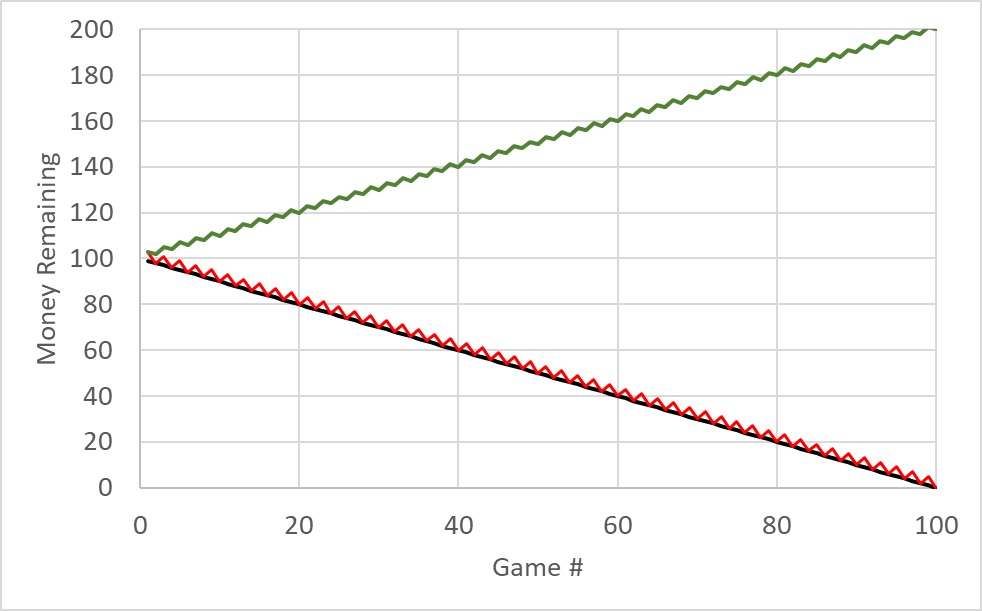
Putting the outcomes of all three games in one place (back represents game A, red represents game B, and the green represents BABA game:

Where is the paradox?

An important thing to notice here is that game A influences game B (and evades the number from being odd before game B starts). The end result becomes counterintuitive, but not a paradox in the strictest sense.

Parrondo’s paradox: Wiki
The Game You Win By Losing (Parrondo’s Paradox): Vsauce2

Parrando’s Paradox Read More »

Median Voter Theorem

Here is another famous proposition in game theory proposed by Duncan Black (1948). The idea is related to the positioning of ideology in the political spectrum but fits equally well in other areas, such as product launches.

Imagine two candidates who want to choose their positions on the political landscape in an election. In a simple realisation, suppose there are 10 positions ranging from extreme left (1) to extreme right (10). If candidate 2 knows that candidate 1 is to make a stand in position 1, what is the best place for the former position herself? Let’s look at the payoff. Candidate 1 will get all the votes of people who hold the idealogy of (in this case) the extreme left. Candidate 2 will get everybody else (from 2 to 10). And if the voters are split equally among the whole spectrum, that becomes 10% and 90% for 1 and 2, respectively. Note that choosing 9 vs 10 also yields the same outcome.

Knowing that candidate 2 will position at 2, the other can now stand at 3 and get all votes from 3 onwards (80%). Continuing this further, you end up at positions 5 and 6. Or the candidates are close to the middle to maximise their chance of winning.

References

Iterative deletion and the median-voter theorem: YaleCourses
Median voter theorem: Wiki

Median Voter Theorem Read More »

Salience Bias

It is a cognitive bias where you focus on certain striking items or information that catch your attention and ignore things that don’t grab the same alert. Salience originates from a contrast between the event and its surroundings. An example is the news of a shark attack on a human – a rare occurrence – that psyches people from going out to the seaside.

Salience bias is critical to be aware of and get under control. In finance, a person’s aspirations to create wealth through long-term investments can derail her reactions to daily market stories about bulls and bears.

Salience Bias: The decision lab

Salience Bias Read More »

Principle of indifference

The principle of indifference is a rule that helps to assign prior probabilities in Baysian-type estimations. It says if there are several alternative possibilities for an event, and there is no particular reason to choose one, the prior – the degree of belief – should be equal among all probabilities. Well, this degree of belief is known as credence.

In the case of coin flipping, the probability that a coin (we don’t know if it is fair or not) lands on the head takes the value, one out of two possibilities, 1/2. Another example is American Roulette and the probability for the ball to land on green (0 or 00). Again, we assign those two prospects equally among 38 pockets, i.e., 2/38 or 1/19.

But if the possibilities partition in different ways, the principle of indifference land in strange situations. See the ‘light switch and ball problem’. There are three balls in an urn – red, blue and green. If I pick a ball at random and it’s red, the light is turned on. If it’s blue or green, the light is off. What is the probability the light is ON?

Well, one can say 1/3 – one in three chances that the ball is red.
One can also say 1/2 because there are two possibilities – the light is ON; the light is OFF!

References

Principle of indifference: Wiki
Principle of Indifference / Insufficient Reason: Statistics How To
The Principle of Indifference: jonathanweisberg.org

Principle of indifference Read More »

Who Knocks Them All? – The Solution

Last time we did match-ups between five individuals and found there is a 31% probability that one player can win all matches. This time, we evaluate it using statistical principles.

What is the probability that a specific individual (e.g., player 1) wins all four matches? It is P(1) = (1/2).(1/2).(1/2).(1/2) = (1/16). It is not difficult to recognise that only one among them gets that chance. If one gets all wins, no one else will (chances of 100% wins are mutually exclusive).

So, the probablity of one player winning all is P(1) + P(2) + P(3) + P(4) + P(5) = 5/16 = 0.312.

Who Knocks Them All? – The Solution Read More »

Who Knocks Them All?

Five players are in a tournament, where each player plays one game with every other. If a player must win every game, what is the probability that one player wins all her matches? The analytical solution is available in the reference below; let’s estimate it numerically.

While the problem is straightforward, I found the coding a bit tricky. Let me explain my logic here step-by-step.

Getting the list of all the matches is perhaps the easiest. Use the function, ‘combinations’ (make sure you installed the library, ‘gtools’).

library(gtools)
play <- combinations(5,2)
play
        [,1] [,2]
 [1,]    1    2
 [2,]    1    3
 [3,]    1    4
 [4,]    1    5
 [5,]    2    3
 [6,]    2    4
 [7,]    2    5
 [8,]    3    4
 [9,]    3    5
[10,]    4    5

Next, take each of these ten combinations and pick a winner with a 50% probability (using the ‘sample’ function).

for (x in 1:10) {
play1 <- c(play[x,])
score[x] <- sample(play1, 1, replace = TRUE, prob = c(1/2,1/2))
}

One such realisation is below:

1 1 1 5 2 2 2 4 5 5

The rest is okay; check a number that repeats four times (four wins). The ‘table’ function can give counts for each number.

table(score)
score
1 2 4 5 
3 3 1 3

The output means (read top to bottom): 1 repeated 3 times, 2 repeated 3 times, 4 repeated 1 time and 5 repeated 3 times.

But we only need the frequency (the ‘times’) four times (if any). For example, in the previous case, if we want to know which number is repeated one time, the following code gives the output.

table(score)[table(score) == 1]
4 
1
length(table(score)[table(score) == 1])
1

The rest is smooth: make a counter for four repetitions, repeat the process a million times and find the average.

itr <- 1000000

win <- replicate(itr,{
  score <- c(1:10)
for (x in 1:10) {
play1 <- c(play[x,])
score[x] <- sample(play1, 1, replace = TRUE, prob = c(1/2,1/2))
}

if(length(table(score)[table(score) == 4]) == 0 ){
  counter <- 0 
  }else{
  counter <- 1  
  }

})


mean(win)

You get 0.312. The analytical solution is 5/16. We will discuss the derivation in the next post.

A probability technique worth knowing: MindYourDecisions

Who Knocks Them All? Read More »

Battle of Sexes – Mixed Strategy

Let’s revisit the battle of the sexes. We have seen the pure strategy Nash equilibria last time, viz. both meeting at the football (Football, Football) or both at Dance (Dance: Dance). Here is the payoff matrix for reference.

B
FootballDance
AFootballA:10, B:5A:0, B:0
DanceA:0, B:0A:5, B:10

But we know, unfortunately, they might fail to reach the equilibria due to communication failure. We continue from there to explore if there is any other equilibrium exists. To find these (mixed) equilibria, let’s assume that A is going to mix at p and (1-p) and B is going to mix at q and (1-q). This means A go to football at probability p and B at probability q. Needless to say, A go to dance at probability (1-p) and B at (1-q).

B
FootballDance
AFootballA:10, B:5A:0, B:0p
DanceA:0, B:0A:5, B:101-p
q1-q

To estimate B’s equilibrium mix ( = q), we need to get A’s payoff. We know how to do that, i.e., calculate A’s expected payoff (pure payoff x probability of finding (q) B at the spot) for football and equate it to its payoff for dance.

10 x q + 0 x (1-q) = 0 x q + 5 x (1-q)
q = 5/15 = 1/3

On the other hand, to estimate A’s equilibrium mix ( = p), we get B’s payoff. B’s payoff for football and equate it to its payoff for dance.

5 x p + 0 x (1-p) = 0 x p + 10 x (1-p)
p = 10/15 = 2/3

So A will go 2/3 of the time for football and 1/3 for dance, and B to go for football 1/3 of the time and dance 2/3 of the time. In other words, even if A mixes the strategy, a better payoff comes by leaning towards football with a higher (2/3) probability. Similar is the case for B with dance.

Battle of Sexes – Mixed Strategy Read More »

Forehand vs Backhand

Amy and Becky are playing tennis

Becky
LR
AmyL(50,50)(80,20)
R(90,10)(20,80)

L-> 50 x q + 80 x (1-q)
R -> 90 x q + 20 x (1-q)

50 x q + 80 x (1-q) = 90 x q + 20 x (1-q) => q = 0.6

L -> 50 x p + 10 x (1-p)
R -> 20 x p + 80 x (1-p)

50 x p + 10 x (1-p) = 20 x p + 80 x (1-p) => p = 0.7

A: (0.7, 0.3)
B: (0.6, 0.4)

Forehand vs Backhand Read More »

Lions and Wildebeests

Here is a puzzle I picked up from the internet: three lions and three wildebeests want to go from one side to the other side of a river. The river has a raft on which, at a time, up to two animals can travel. There is one problem, though. If the number of lions exceeds the number of wildebeest in one place, the lions would attack and kill the latter. So, how do they all reach the other side without issues?

Decision-making process

Let’s do a systematic decision tree that includes all (allowed) possibilities. What are the starting possibilities (trip 1)? They are one lion taking the raft (L), one wildebeest taking the raft (B), two lions (LL), two wildebeests (BB) or one lion and a wildebeest (LB). We will ignore L and B from the list because we know they must return (trip 2), thus nullifying trip 1. Therefore, the valid moves are:

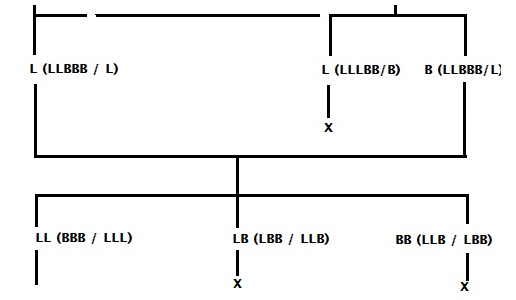
An explanation for the shorthand: There are three options for trip 1 – LL, BB and LB. The notation in the parenthesis is the expected outcome in the end, e.g. if LL happens. And what remains on the start shore is LBB, and the endpoint (after the “/”) is LL. “X” means the move is unacceptable (three lions and one wildebeest on one side). The possible next actions (trip 2) are:

I guess the notations and the outcomes are clear by now. One of the trips (L) is not possible; it leads to 3 lions on one side. There are two possible remaining moves, and interestingly, both will lead to the same outcome (LLBBB/L). So, the next trip (trip 3) starts from a common origin (LLBBB/L).

Trip 4:

Trip 5:

The following six trips are:

Can you solve the river crossing riddle? – Lisa Winer: TED-Ed

Lions and Wildebeests Read More »