The Raven Paradox

German philosopher Carl Gustav Hempel introduced this in the 1940s, questioning what composes evidence for a hypothesis. Here is how the paradox works:

You see a raven, and it is back. Then you see more ravens, and they all tend to be black. These observations prompt the scientist in you to form the hypothesis that all ravens are back.

So far, so good. Now it becomes a conditional (statement of the form: “if A, then B”). As per logic, a conditional is equivalent to its contrapositive:

If A, then B == If not B, then not A

For ravens, the equivalent statement is:

All ravens are black == All non-back things are non-raven, or if an object is not black, then it is not raven

Now let’s collect evidence for the hypothesis. Every black raven is a piece of evidence. Every non-black non-raven also has to be evidence! Green grass, red shirts, and yellow flowers are some examples.

So, what is the issue with this? Well, there could be rare non-black ravens which escape our sight. In the original form of the hypothesis (conditional), you only sample ravens and verify their colour. But in the contrapositive form, you can potentially collect an infinite number of objects (every non-black entity in the world) and appear to strengthen your hypothesis significantly.


The Raven Paradox Read More »

It’s Not Fair!

Inequality aversion is a concept in behavioural economics. It means humans have a notion of fairness and will reject what they consider as inequalities. This psychology is responsible for individuals refraining from targeting higher rewards if they perceive another party getting better incentives. We have seen this in the centipede game.

Kahneman et al. report results from their study in which they carried out telephonic surveys on the residents of Toronto and Vancouver. Each participant got a maximum of five questions regarding fairness in a telephonic interview.

Question 1

A hardware store has been selling snow shovels for $15. The morning after a large snowstorm, the store raises the price to $20. Please rate this action.” 80% of the respondents thought it was unfair.

Question 2

Question 2 has two parts. 2A: An employee is working in a photocopying shop at a wage of $9/hour. Upon seeing unemployment rising in that area and noticing other smaller shops paying $7/hour for their employees, the owner reduces the employee’s wages to $7/hour.
2B: An employee is working as in question 2A. After she leaves, the employer recruits a new person at a wage of $7/hour.

To question 2A, 83% of the respondents replied as unfair, and to 2B, only 27%.

House on rent

Similar ideas of fairness exist in residential tenancy. Different rules of rent-hikes are accepted for a new tenant (higher tolerated) vs a tenant renewing the lease (lower). At the same time, people thought it was ok if the landlord sold the house and the new owner charged higher rent from the existing tenant!

Reference

Daniel Kahneman, Jack L. Knetsch and Richard Thaler: Fairness as a Constraint on Profit Seeking: Entitlements in the Market, The American Economic Review, 1986, 76(4), 728

It’s Not Fair! Read More »

What is in the Envelope

Here is a puzzle. There is a 200 EURO currency in one of the two envelopes, A and B. If you guess the right one, you can get the cash. Additionally, you can avail of a clue, which works as follows: There is a jar with five balls in it – three of them having the alphabet (A or B) of the envelope that carries the currency and two with the other alphabet. You can pick on the ball at random if you like. The price to pay for the clue is 25 EURO. The questions are:

1) Is the clue worth 25 EURO?
2) If not, what is the maximum amount you would like to pay?
3) Would you be willing to pay for a second clue and pick up another ball?

Let’s answer the first question. The expected value from the guess without taking any clues is 0.5 x 200 + 0.5 x 0 = 100 EURO. It is because there is a 50-50 chance that your guess turns right. What is the expected value of the guess with the first clue? It is 0.6 x 200 + 0.4 x 0 = 120 EURO. When you pick one ball, there is a 60% (0.6) chance that it is the right one (3 out of 5) and a 40% chance it is the wrong one.

Therefore, the maximum added value of going for the clue is 120 – 100 = 20 EURO. So, the answer to the first question is NO, and the second is 20 EURO.

What about a second pick? To answer this, we will need to perform several conditional probabilities using our favourite Bayes’ rule, which we’ll do next.

Is Extra Information Helpful? A Probability Puzzle: William Spaniel

What is in the Envelope Read More »

Money and Behaviour

Psychological experiments, despite their imperfections, still offer valuable insights into human behaviour. Well-known Imperfections are their lack of reproducibility and the nature of participants – typically originate from a narrow distribution of the society, e.g. students. The paper from Kathleen Vohs, Nicole Mead and Miranda Goode is an example we want to discuss today. They investigated how the notion of money (actual cash or a mere thought) can change one’s attitude while doing a job.

Self-sufficiency hypothesis

Before we get into the details, let’s understand what is meant by self-sufficiency. It is a concept where an individual recedes from the collective to herself and spends her effort towards achieving personal goals. The objective of the experiment was to verify the hypothesis that the concept of money can make a person self-sufficient.

Two tasks

The experiment consists of two tasks: 1) descramble 30 jumbled words, and 2) complete a challenging problem of arranging 12 disks into a square.

Three groups

The participants are arranged into three groups. Control group – gets neutral words to descramble and do the second task; the play-money group – gets neutral words in task 1 but primed with a pile of monopoly money while doing task 2; the money-prime group – gets money-related words to descramble and then do the second task. Before leaving the room, the investigator mentioned his availability to help if required. Therefore, the measurement parameter of the experiment was persistence (time before a participant seeks help).

The results

The results fulfilled the hypothesis – the money groups (money-prime and play-money) both parties took the job seriously and spent more time before approaching the investigator for help. The mean times were money prime = 314.06 s (sd = 172.79); play money = 305.22 s (sd = 162.47) and control = 186.12 s (sd =118.09).

Kathleen D. Vohs, Nicole L. Mead, Miranda R. Goode, The Psychological Consequences of Money, Science, 2006, 314.

Money and Behaviour Read More »

What Asteroid Ryugu Tells Us

I’m sure you remember Miller–Urey experiments that, in the 1950s, generated molecules of life by passing electric discharge over a mixture of methane (CH3), ammonia (NH3), water (H2O) and hydrogen (H2). The molecules reported were amino acids such as aspartic acid, glycine, alanine and alpha-amino butyric acid.

Ferus et al. in 2017 went even further. They shone electric discharge (simulating lightning) and laser (simulating asteroid plasma) on a mixture of NH3, CO and H2O, producing RNA nucleobases – uracil, cytosine, adenine, and guanine.

Straight from space

While laboratory experiments such as these demonstrated the origin of fundamental molecules from simple gaseous species present in the universe, it can never replace evidence from space, the true cradle of these building blocks of life. And that’s what happened when scientists analysed samples from an asteroid.

The team led by Yasuhiro Oba analysed samples collected in 2018 from asteroid Ryugu and found uracil, one of the four bases of RNA.

Pristine sample

The beauty of this sample is that it was uncontaminated by anything from the earth as it was collected and sealed at the asteroid surface by the Hayabusa2 mission.

Studies like these suggest that foundations of life, such as the molecules of interest, might have been formed in carbonaceous asteroids and delivered to the early earth.

Reference

Yasuhiro Oba et al.; Nature Communications, 2023, 14:1292

Asteroid sample study: The conversation

Stanley L Miller, A production of Amino Acids Under Possible Primitive Earth Conditions, Science, 1953

Formation of nucleobases in a Miller–Urey reducing atmosphere, PNAS, 2017

What Asteroid Ryugu Tells Us Read More »

The Pirate Problem

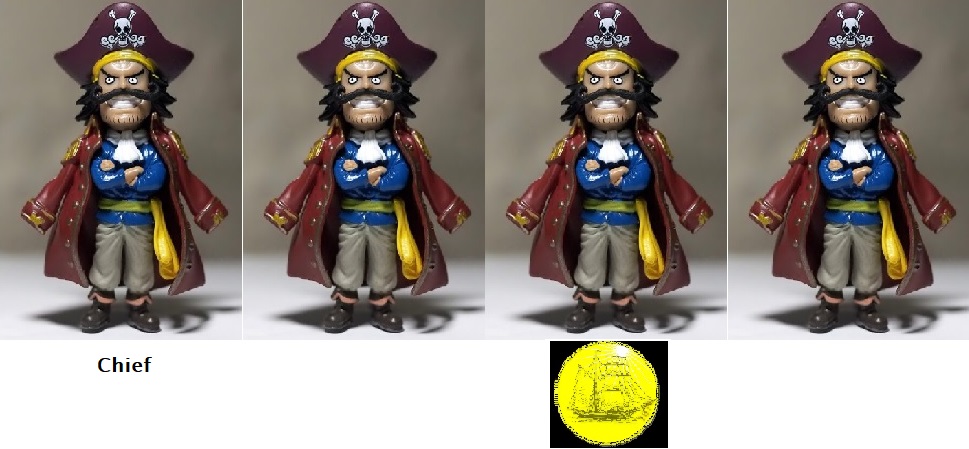
The pirate chief and his four mates found 100 gold coins and wanted to divide them among themselves. As expected, they are perfectly rational and strategic people. Here are a few rules.

  1. The leader can propose a division.
  2. If half of the team (including the leader) accepts the proposal, it becomes valid.
  3. If not, the chief will be thrown out, the next in line will become the chief, and the game will continue.

So, what should be the chief’s offer to survive?

To find the solution to this problem, we must start from the last pirate and work backwards.

If the last one becomes the chief, he doesn’t need to make any offer and can keep all 100 coins. Simple! But what happens if two pirates remain? Then, the chief can decide not to give anything to the last one as he secures the approval by voting himself.

So, moving another level up – with three pirates. The chief requires at least two votes, but he gets one, i.e., his own. Also, he doesn’t want to give away more money than he needs to. Which of the other two pirates is cheap to buy? There is no point in giving money to the next person as he will disapprove; he knows he can keep all the coins by becoming the nest chief. Therefore, the last guy will vote for the current chief if the former gets at least one coin.

Now, four. The chief needs one more vote. He looks at the three and figures out what would happen if he loses, and the second one becomes the new chief. If that happens, the third one will not get any coin. Therefore, he becomes the cheapest vote to buy.

In the last case, the original case with five pirates, the chief needs three votes to survive. One comes from him, and he needs to buy two more. There is one cheap way: we know what happens if the proposal fails and the next becomes the chief. That will lead to the third and fifth not getting any coins, and they know that. So buy those two.

The Pirate Problem Read More »

Cournot Duopoly Game 

Cournot Duopoly is an economic strategy game where two firms producing the same type of products compete for the market by controlling their output. It is a simultaneous move game, and there is no collusion.

Let the firms be 1 and 2 choosing to produce q1 and q1 quantity of goods. In this model, they only decide how much to make. The price will be determined by the market using an inverse demand curve. So, price P = a – b x Q, where Q = q1 + q2 and a and b are positive numbers.

The marginal costs of production are C1 and C2, respectively. These suggest the profit of firm 1, Profit 1 = revenue – cost = P x q1 – C1 x q1. Similarly, Profit 2 = P x q2 – C2 x q2.

Profit 1 = (a – b x (q1 + q2) )x q1 – C1 x q1
= (a – bq1 – bq2 – C1)q1
Profit 2 = (a – bq1 – bq2 – C2)q2

Nash Equilibirum

To get the Nash equilibrium, we’ll maximise the payoffs (profits) of firm 1 and firm 2 by differentiating with respect to q1 and q2 and setting them to zero.

d(Profit 1) / d(q1) = a – 2bq1 – bq2 – C1 = 0
d(Profit 2) / d(q2) = a – bq1 – 2bq2 – C2 = 0
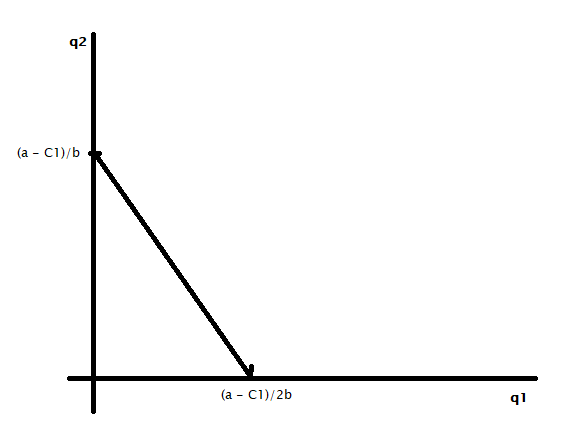
q1 = (a – bq2 – C1)/2b
q2 = (a – bq1 – C2) / 2b

So, q1 is a function of q2 and vice versa. The first equation, a straight line, will look like the following.

Cournot Duopoly Game  Read More »

Road Safety in India – Comparison with the US

In the last three posts, we have been looking at the statistics of road accidents in India. It would be interesting at this stage to compare that with the US.

ParameterThe USIndia
Population
(mln)
3301321
Fatalities38,824131,714
Fatalities per
million population
117.65100
Injured
Persons
2,282,015348,729
Injured per
million population
6915263
Crashes/
Accidents
6,393,624366,138
Accidents per
million population
19374277
Survival probability
Injured /(Injured +fatality)
0.980.72

Road Safety in India – Comparison with the US Read More »

Road Safety in India – Survival rate

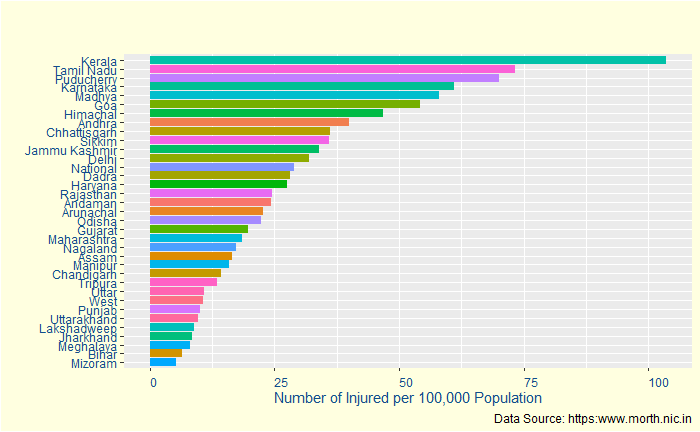
In the final episode of accident data analysis, we will go into the remaining key stats – injuries and fatalities – and postulate a potential problem with the interpretation, i.e. data registration. But first, a plot of the number of injuries per population.

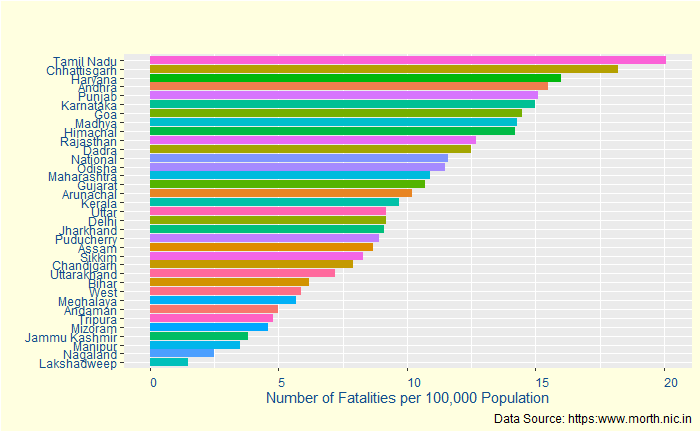
Kerala is now 33% more than the nearest rival, almost suggesting it is the most dangerous state for a passenger. But is that entirely true? Let’s see the following statistic – the fatalities per 100,000 population.

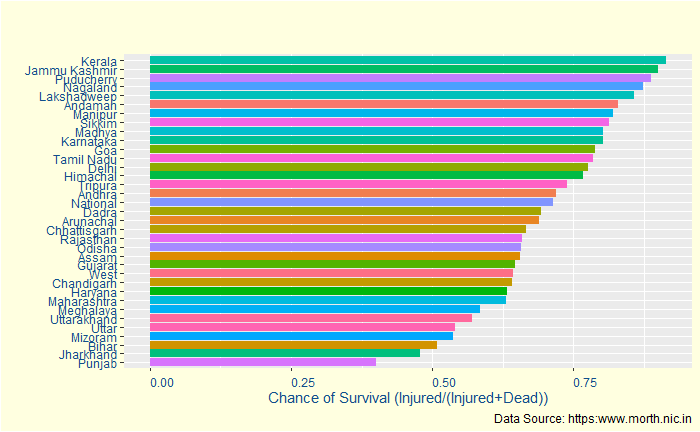
Strangely, it moves down to the 16th. Puducherry, which is third in injuries, also goes down. To understand this better, let’s define survival rate = the number of injured / (number of injured + number of dead).

Yes, Kerala has a > 90% survival chance after an accident. It may indicate a few things:
1) Kerala has better accident care for the injured (that prevents them from dying)
2) Kerala has more proportion of low-intensity accidents compared to other states
3) Kerala’s registration system is more thorough in recording incidents. And higher survival rate is an artefact of having a higher reporting rate of all incidents, however minor it could be.

Not so fast

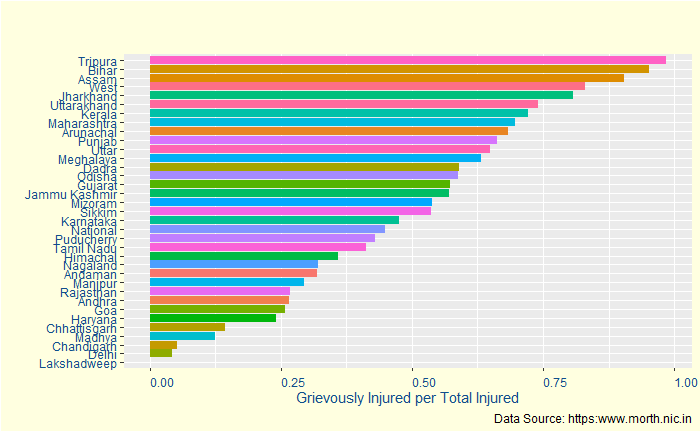
When you are about to conclude data collection, here is another one: the proportion of grievously injured people among the total Injured.

Almost 75% of the injured are seriously injured. So to conclude, Kerala remains one the most dangerous for road safety, but most of the injured are somehow saved, despite the severity.

Road Safety in India – Survival rate Read More »

Road Safety in India – Dangerous States

One of the rather unfortunate aspects of statistics is that it doesn’t say why something has happened. They also can’t reveal data quality, making it difficult to compare different entities. Therefore, it leaves the burden of interpretation in the hands of the (responsible) reporter. Not always a desirable combination! With this introduction, let’s continue with the road safety data. This time we go deeper into state-level statistics.

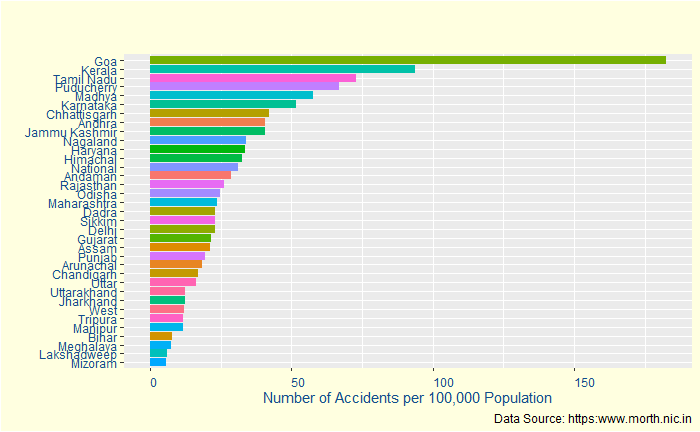
Number of Accidents

Does this make Goa the most accident-prone region? Not necessarily. It is one of the smaller states in India with about 1.4 mln population. The same goes for Puducherry, at number four, with a quarter of a million. If you want to know the difficulties of interpreting data from a smaller population, read this post. Another factor is the incident reporting system. It may not be a coincidence that the top four regions are also known for better data recording, with the three among the four (Kerala, Goa and Puducherry) at the top-5 of the human development index. We’ll come back to this a bit later.

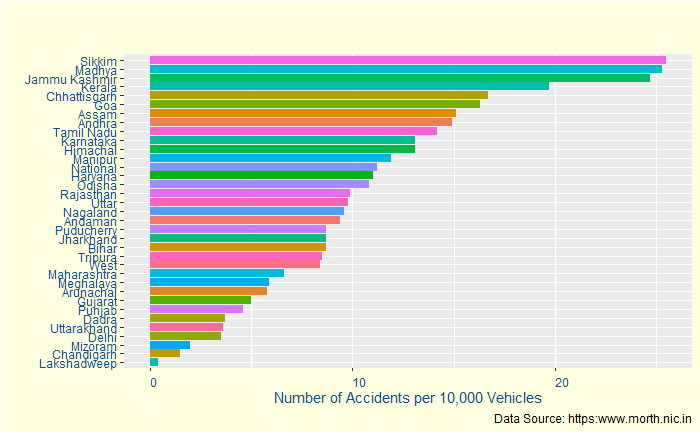
The same statistics on a different basis – the number of accidents per 10,000 vehicles – are below:

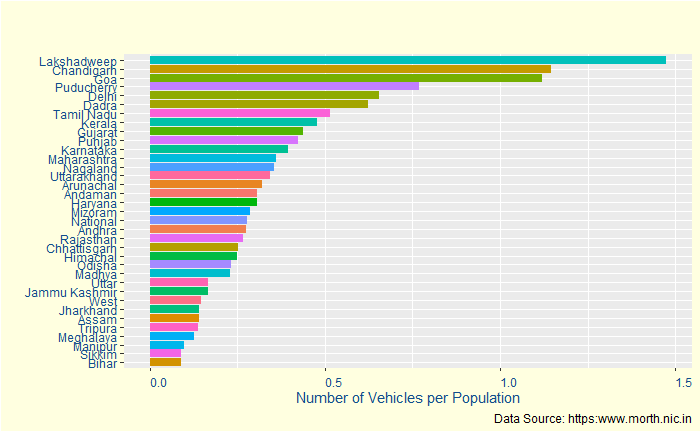
Before we move on: let’s try and understand if we can explain the top candidates based on their vehicle per population density. For that, we divide accidents per 100,000 population with accidents per 10,000 vehicles and divide by 10.

Yes, the top regions (Sikkim, Madhya Pradesh and Jammu & Kashmir) of the previous plot are way down in this plot. Again the statistics of smaller samples. That leaves one curious entity that we haven’t addressed so far – Kerala, which is among the top so far, not so small in population (33 million) or in vehicle density (~ 0.5). More about this coming up next.

The R code used for building the plots is below:

state_data %>% 
  ggplot(aes(x=reorder(State, Acci_per_Pop), y=Acci_per_Pop, fill = State)) + 
  geom_bar(stat = "identity") +
  geom_col() +
  coord_flip()

HDI of Indian States: Wiki

Road Safety in India – Dangerous States Read More »